• Skip to primary navigation
  • Skip to main content
  • Skip to primary sidebar

Adam Fletcher Adventure Series

Bestselling, family-friendly historical fiction set on the colonial North Carolina coast

  • Home
  • The Author
  • Blog

Editor

Into the Backcountry – Book 7 is coming Summer 2021!

Finally! ????

Now that I can see the light at the end of the tunnel on Adam Fletcher Adventure Book 7: Into the Backcountry, I can finally report the expected launch time!

I fully expect the book to be available SUMMER 2021.

It may be mid-Spring, but that will be determined by the schedule of my new copyeditor.

What will it be about?

I ended up not departing too far from what I had originally planned to do, although I did scrap some story elements that were just frustrating me too much.

That means in Book 7, Adam will be traveling into the colony™s interior to seek a man on behalf of his grandfather. As you might expect, he gets into trouble here and there along the way, but he™s determined to see it through to his destination and make it back home in one piece.

After all, now he has a young lady anxiously awaiting his return.

Stay tuned, friends!

Summer Raffle! 50 Winners! When America Was Young Historical Fiction Ebook Bundle

This contest has ended.

Forty (40!) winners will receive the When America Was Young Box Set

This historical fiction ebook bundle includes the following titles:

  • The Smuggler’s Gambit by Sara Whitford (Adam Fletcher Adventure Series, Book 1)
  • The Smoke by Lars D. H. Hebdor (Tales from a Revolution Series)
  • Ella Wood by Michelle Isenhoff (Ella Wood Series)

Everyone has TEN CHANCES to enter this raffle. 

  1. Subscribe to each of our mailing lists (3 entries)
  2. Follow us on Amazon (3 entries)
  3. Follow us on BookBub (3 entries)
  4. Share this raffle with your friends!

Ten (10!) grand prize winners of 3 ebook bundles by 3 authors–spanning 100 years of American history.

This exclusive box set includes three young adult historical fiction authors with three complete novels representing three series and three periods in American history.

The Adam Fletcher Adventure Series Box Set (Books 1-3) by Sara Whitford

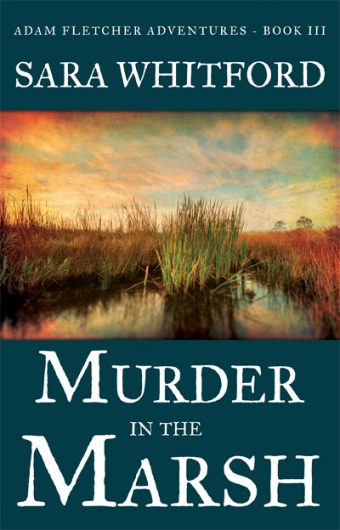
Includes – The Smuggler’s Gambit, Captured in the Caribbean & Murder in the Marsh.

The Smuggler’s Gambit

Port Beaufort, North Carolina – May 1765

Seventeen-year-old Adam Fletcher is no stranger to fist fights, but when he bloodies the nose of the obnoxious son of Port Beaufort’s customs agent, the local magistrate offers Adam two choices: jail or an apprenticeship.

Choosing the latter, he soon finds himself bound apprentice to a reclusive old man with a secret, colorful past. Although Adam is less than thrilled about his new situation, when he is asked to spy on his master as a suspected smuggler, he has to decide where his loyalties lie. Will he perform his civic duty to the Crown, or will he do whatever is necessary to protect the old man, possibly putting even his own family in danger?

PUBLISHERS WEEKLY says, ”Whitford delivers an enjoyable tale.” Readers love this family-friendly adventure!

Captured in the Caribbean

June 1766 “ Havana, Cuba

Adam Fletcher begins a life-altering quest when he travels to help deliver cargo in the West Indies. Not long after the Carolina Gypsy arrives in the bustling port of Havana, Cuba, Adam ventures out on his own to track down a man who he has been told may have information about his father.

His plans are complicated, however, when he ends up being taken hostage by the very men he hired as interpreters.

When his shipmates receive a ransom letter, they launch a desperate search to find him, but meanwhile, Adam plots his own escape from the hands of his captors. Once he discovers who™s behind it all, he starts thinking that maybe he should have left well-enough alone instead of trying to dig up secrets that were buried in the past.

Murder in the Marsh

Port Beaufort, North Carolina – December 1766

After a tumultuous time in Havana where he uncovered more family secrets in a week than most people do in a lifetime, Adam Fletcher is grateful things are finally starting to get back to normal.

That is, until an inexplicable series of brutal crimes in the region hits a little too close to home. Suddenly, Adam finds himself in the middle of hunting down clues to try and identify the suspect, or suspects, in three different murders, one of which has a mystery victim.


Tales From a Revolution by Lars D. H. HebdorTales From a Revolution Box Set by Lars D. H. Hebdor

Click here to visit his website. 

Ordinary People in Extraordinary Times

The question of how the American colonists made the long trip from being subjects of the British King to being citizens of the independent United States has nearly as many answers as there were people. Within these collected Tales From a Revolution, you’ll be transported to the time when the American Revolution tested how a young farm boy from Vermont, a Quaker blacksmith, and a Tuscarora clan member would all navigate the tumultuous times of the American Revolution.

The Prize

The Biggest Heroes are Sometimes Unsung
Caleb yearns to join his father, serving with Ethan Allen™s Green Mountain Boys to defend Lake Champlain from the British. His duties on the family farm consume him, but then a fateful encounter with an unlikely neighbor changes everything. Pulled into new intrigues and new friendships, can Caleb keep his community safe, or will the entire Revolution meet its doom on the waters of the lake?

The Light

Caught Between the Impossible and the Forbidden
As a blacksmith in the quiet town of Trenton, New-Jersey, Robert Harris was accustomed to working with the challenges of fire and steel. The outbreak of open warfare, though, will test his Quaker faith, and its command to avoid all violence. With enemy forces occupying the town, and a former business associate determined to destroy his family and friends, can Robert find a way to protect his pursuit of what’s right?

The Smoke

They Should Have Been Enemies, But They Became Brothers
Joseph Killeen was sent into the wilds of frontier New-York to eliminate the threat of savage enemies in the forests of New-York, but when he meets Ginawo and his peaceful Skarure village, he realizes that nothing is as simple as he was told. The Haudenosaunee Confederation is being torn asunder by the American Revolution, forced to choose sides in a fight that’s not their own. Can Joseph and Ginawo bridge the divide between their peoples, when warfare threatens to destroy both societies?


The Ella Wood Trilogy by Michelle IsenhoffThe Ella Wood Trilogy by Michelle Isenhoff
Click here to visit her website. 

“Poetic” and “nuanced,” this sweeping Southern saga tells the story of one young woman standing at the edge of war and struggling with questions of morality, purpose, and love.

As slavery pushes the nation toward war, Emily must battle her father in her own bid for freedom. She™s prepared to pay any price to escape the plantation and attend a northern university newly opened to women. Meanwhile Thaddeus Black, her handsome and unwanted suitor, simply won’t take no for an answer. While her mind is willing to strike out alone, her heart stubbornly refuses to accept that a choice for independence must be a choice against love.

Follow Emily from heartbreak to hope as this critically acclaimed series carries her through the tragic years of the American Civil War. Titles in the series: Ella Wood, Blood Moon, Ebb Tide.

Reader-nominated for a 2016 Cybil™s Award (Blood Moon).


Contest begins at 12:00am June 12 and ends 12:00am June 26.


a Rafflecopter giveaway

Some History of the Great Dismal Swamp

While researching The Stolen Bride, the forthcoming installment in the Adam Fletcher Adventure Series, I’ve spent some time researching the history of the Great Dismal Swamp.

I was curious about a few things:

  • When and how did it get its name?
  • What was it like in the colonial era?
  • Would travelers have been able to traverse the swamp, or would the inhospitable conditions make it necessary to skirt around the place?

I’ve learned quite a bit about it, but one of the most interesting things is a letter that I found in the Colonial Records of North Carolina that was written by William Byrd II, who is one of the most well-documented planters from the colonial era. He’s known for founding the City of Richmond (between 1737-1742), but a decade earlier, in 1728, he surveyed the border between North Carolina and Virginia. (His findings were reported in The History of the Dividing Line betwixt Virginia and North Carolina, Run in the Year of Our Lord 1728.)

Byrd was Virginia’s version of Edward Moseley (the Surveyor General who came after John Lawson in North Carolina, famous for the Moseley Map of 1733).

Being thus appointed, we sat out on the 27th of February 1727/8 to Corotuck Inlet, where we met the Commissioners on the part of North Carolina and having concerted the place of beginning the allowance to be made for the variation and other necessary Preliminarys we entered on the Business the 27th of March following. T’is not easy to conceive, My Lords how much difficulty and fatigue we encountered in the low marshy grounds that lay near the sea, our course being right forward, thrō thick and thin and leading often through swamps and miry places not practicable for horses for many miles together. Our way lay through the widest part of the Dismal which is a dreadful swamp of vast extent not less than 30 miles long and 15 in breadth. No humane creature ever had the Resolution to pass over this inhospitable Bogg before, and we found it so intolerable that I believe no man will ever be so hardy as to pass it again Your Lordships will incline to the same Opinion when I assure you that with the utmost diligence we cou’d use it took us up full ten days to mark and measure that small distance. However we had patience enough to overcome this and all other difficulties that stood in our way. We carried on the business with very great alacrity and success til the begining of April when the weather grew warm enough to give life and vigour to the Rattlesnakes. This obliged us to discontinue our work til the return of the cool season, which could not happen til September

Accordingly we met again on the 20th of that month at the place where we had left off and pursued the line with all the Industry we were able.

And now My Lords for variety we had quite different hardships to undergo, which were however as discouraging as those in our former Expedition. Great part of our journey lay through wild woods without path and without any Inhabitants except only Panthers, Bears, Wolves and other savage beasts. In many places we were forced to scuffle through Thickets so intolerable that it was as much as our hands cou’d do to save our Eyes in our heads. At other times our line carried us over steep hills & stony Precipices to the no small hazzard of our Necks. Nor was this all our danger but we were constrained to ford very often over unknown Rivers, where the stream was rapid, and the Bottome paved with Rocks as slippery as glass so that t’was hardly possible for horses to keep their feet. Foreseeing the difficulty of these ways for Baggage horses we carried no provisions with us but Biscuit, depending entirely on Providence for other subsistance. Our lodging was in the open air, and our Drink water: but what was worse than all the rest by the time we approached the mountains our horses were so jaded that we were obliged to walk great part of the way home on foot and that in Boots for fear of Bushes and vermine. However we bore up against all these Inconveniences not only with constancy but cheerfulness determining that nothing should discourage us from obeying his Majestys order in the fullest extent. And we endured it all with the more Patience because our endeavours were blest with very uncommon success. We had no Distemper no Disaster of any consequence befell any of the Company during the whole time, and we brought all the people back in better health than when they went out Nay for 16 weeks no man that was with us ever wanted a meals meat so bountifully did Providence supply us day by day in the barren Wilderness. Our Governor has had the honor to write to your Lordships upon this subject and to transmit the Map and the Journal of our Proceedings by which you will be the better able to judge of the service we performed and of the Fatigue we underwent. But as this has happened by his Majesty’s special direction he is unwilling to determine what pay we ought to have, but desires to be directed by your Lordships both as to the Quantum and by which of our 2 Revenues this Charge ought to be defrayed whether by that of the Quitrents or by that of the Two shillings per Hogs head?

As to the first of these Questions, how much the Commissioners ought to have for the trouble and expence of this Expedition your Lordships have a Precedent to go by which we humbly hope will guide your Opinions in this case. In the year 1710 two Commissioners Phillip Ludwell and Nathaniel Harrison Esqrs were appointed by our Governor and Council to do this very Business. These Gentlemen went to Corotuck Inlet in order to begin from thence: but not being able to agree with the Commissioners of North Carolina they returned without performing any thing. However they having been out 4 weeks and it not being their fault that nothing was done they were paid by an order from England one hundred pounds sterling each. Now if those Commissioners were allowed £100 for 4 weeks without enduring any hardship or doing any service I humbly submit it to your Lordships how much we ought to have, who were 16 weeks out, underwent all manner of fatigue and performed the Business faithfully & effectually which we had the honour to be imployed upon. The surveyors likewise hope they may be considered in the same proportion that the former surveyors were, namely 20 shillings a day which I think they deserve for the great fidelity & exactness with which they discharged their duty. And our Chaplain Mr Peter Fontain hopes he may have as much as the surveyors, having been very diligent in his Function & having christened above an hundred children among the Gentiles of North Carolina.

Then my Lords as to the second Question out of which Revenue this money ought to be paid I humbly conceive your Lordship will think it most reasonable that it be paid out of the Revenue of 2 shillings per Hogshead since that was given to defray both the constant and accidental charges of this Government. And the rather because this Fund is now in very good condition having several Thousand Pounds in Bank and in no danger of being deficient. Indeed formerly when this Revenue happened to fall in arrear (which was the case when the Payment was ordered to the Commissioners above mentioned) such services have been defrayed out of the Revenue of Quitrent. But at present the case is quite otherwise and there is a large summ in Bank of the Two shillings per Hogshead and consequently the present charge may be more naturally born by that Revenue and the rather because the Quitrents have lately been reserved for more important services.

This my Lord is a faithfull state of our case nor can I imagin that our Pretentions can be at all prejudiced by the purchase that has been since made of Carolina by the Crown Since what we did was by his Majesty’s express commands. And notwithstanding such Purchase this work will still prove very advantagious to the Publick by discovering a fine Country which will soon be taken up as far as the great mountains whereby the strong Barrier will be secured to his Majesty’s subjects. Besides our line will remain a lasting Boundary between the 2 Colonys which can never conveniently be united into one Government.

And now I ought to ask your Lordships ten Thousand Pardons for giveing so long an interruption to your attention to the Publick service. But as I could not make my case shorter without prejudicing the Justice of it I hope you will be pleased to excuse me, and to believe that I am with all the Respect in the World

My Lords Your Lordships most obedient humble servant
W. BYRD.

Townsends’ Treasures: 10 of my favorite episodes

If you love colonial American history and you haven’t started watching Townsends’ channel on YouTube yet, you are missing out.

Something about the end of one year and the start of a new one seems like a great time for countdowns… or Top 10 lists, so I figured I’d make one about one of my favorite guilty pleasure research tools ” Jas. Townsend & Son, known more recently as simply Townsends ” on YouTube.

I first learned about the channel from a video they released about seven years ago and I’ve been a huge fan ever since. In no particular order, here are 10 of my favorite episodes from the channel. (I have many other favorites, but I’m trying to narrow it down here… 😉 )

1. How to Build an Earthen Oven

As soon as I started watching this several years ago, I knew it was a project I wanted to tackle, but you know what? I still haven’t done it yet! My teenage son has now told me he’ll help me make one of these in 2019, so expect a post about that when we do it ” documenting either our success or our spectacular failure. We’ll see!

After you watch the video below, you’ll want to check out the one where he bakes bread in it, right here.

2. These Plants Could Have Saved You – Historical Herbal Medicine

Ever since my college days, when my mom regularly administered doses of White Oak Bark tea along with Echinacea and Goldenseal Root to help me beat Mononucleosis in a little over a week, I’ve been a big fan of herbal remedies. I’m not so hard-nosed about it that I won’t take regular pharmaceuticals when I need them, though. Nevertheless, anything about old-timey preparations or traditional healing methods fascinates me.

Even though this particular video is set in a nineteenth century village, the same remedies might have been used in the colonial era. (Side note: I can’t help but recommend this book. I’ve referenced my dog-eared copy many, many times for almost 20 years now!)

2. Lives of the Downtrodden in Early America

I love travel journals. Interestingly, when Townsends released this video I had only a couple of months earlier been poring over the very journal by William Byrd that is mentioned in this video. In 1728, Byrd was commissioned to survey the dividing line between North Carolina and Virginia and as Jon details below, there were two versions, the official one, and the unofficial one, which captured his more down-to-earth sentiments about the things he had encountered during his travels. (I studied his journal while working on The Stolen Bride, as Adam passes through the area from North Carolina into Virginia.) Prior to talking about that, Jon cites a wonderful entry from the journal of Sarah Kemble Knight, in which she discusses a family living in “wretched” conditions on the side of a river that she was waiting to cross, and yet she talked about how clean and tidy and happy they were, in spite of their few possessions.

Watch this one. It’s a very sweet and touching video, and if you just take a moment to think back on those times, you can almost smell the little wood fire and see the proud smile of these materially poor, but joyful, souls in early colonial America.

4. Q & A – Dogs in the 18th Century

Ok, so this whole video isn’t about dogs, but about half of it is, and I love dogs, so I definitely loved hearing Jon talk about dogs in the colonial era. He shows several pieces of art from the era that demonstrate that ” just as they have been throughout history ” dogs were man’s best friend in the 18th century, too!

I’ve queued up this video to start at the part where he’s talking about dogs, but you might find the whole thing interesting.

5. Fire Starting: No Matches, No Lighter – The American Frontier

I’m not sure what it is. Maybe it’s that I come from ancestors who farmed for centuries until my parents’ generation, but my whole family is all about being able to be resourceful with what you have; to know how to live off the land if needed. My dad was prepping before it was cool. (Not crazy person, build an end-of-the-world-bunker-underground-type preppier, but the kind of guy who wanted to have ample supplies to take care of his family if the proverbial you-know-what hits the fan.) My mom is all about growing things; even rooting plants without seeds. (So cool!)

While I already know about starting fires without matches (and in fact, I wrote about it here), I love watching Townsends videos where Jon brings in guys like Dan Wowak of Coalcracker Bushcraft to talk about the basics: fire, shelter, cordage, etc.

In this particular video, Dan discusses using flint and steel and char cloth to get a fire going in potentially damp conditions.

6. Planting an Herb Garden with 18th Century Favorites

Jon and his daughter, Ivy, plant a basic herb garden in this video. This isn’t about just medicinal herbs, but these sorts of gardens would’ve also been used for some vegetables and things. He’s referencing The Universal Gardener and Botanist by Thomas Mow.

7. Springtime Soup Made with Wild Greens

Some of my favorite Townsends videos are the cooking episodes. There are so many, it’s hard to choose from them which ones to feature here, but I picked this one because I love the idea of using wild greens like dandelions and wild garlic to make a springtime soup. He also mentions using his portable soup base in the video. There are at least three videos worth watching that deal with that topic, here, here, and here.

8. A Survival Item from Tree Bark ” The American Frontier

Yep. Another video with Dan Wowak. I love this one. In it, he and Jon make cordage out of tree bark. How practical is that?! If you were off camping in the woods and realized you needed to tie something up (or down), it’s a helpful skill to know how to make cordage out of found materials. He also uses a trick that I learned when I was a girl ” cutting a seemingly endless cord from a circle of buckskin or other tanned hide.

9. Roast Beef Over an Open Fire!

What’s not to love about this? I love roast beef! And he’s cooking it according to Amelia Simmons’s recipe ” over an open fire! I really need to try this sometime… outdoors. 😉

10. Dutch Oven Baking: Getting to Know the Utensil

It’s amazing what can be done with a Dutch oven. Maybe one of these days I’ll come up with something that ties in with the Adam Fletcher books to cook in my Dutch oven and do a video.

Well, that’s all for now! What did you think of this post? If you enjoyed it, let me know in the comment section below and I’ll try to do more on other similar topics. If you aren’t already, I hope you’ll enjoy watching more of Jon Townsend’s videos at YouTube, plus you can visit Jas. Townsend & Son’s online store here.

Christmas in Beaufort

An Adam Fletcher Adventure novella just in time for the holidays!

This is a quick, fun read for this special time of year. It will hopefully be a welcome side trip after the intense adventure of The Stolen Bride.

I fully anticipate the next book in the series (the as-of-yet-untitled book 7!) to be action-packed, so just know that it’s coming sometime in 2019, Lord willing!

One more thing before I forget: Christmas in Beaufort has some special bonus content, including Colonial American Christmas Recipes, complete with commentary by the author (and one contemporary recipe for Layered Coconut Cake), and some Colonial American Christmas trivia. I’ve also included an excerpt in the very back of the book from the real Christmas story, just because it makes me happy. ????

Order your copy via the links below.

Amazon
B&N
iBooks
Google  Play
Kobo

To get the print version before Christmas, I recommend ordering directly from Amazon.com ($7.98 USD). Other booksellers will likely be able to order the book, but it may not come in before Christmas.

(For Adam Fletcher readers around the globe, I don’t have the links yet to order the print book from your own country’s Amazon, but it should be available any day now so check your site throughout the week.)

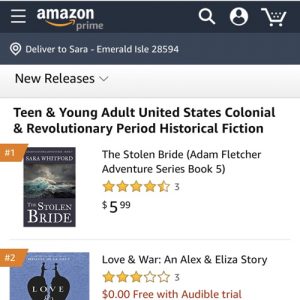
The Stolen Bride is an Amazon #1 New Release

The ebook version of The Stolen Bride was launched at the end of May and it has occupied the #1 spot on Amazon’s Colonial Historical Fiction New Releases since that time. This is entirely thanks to all of you!

I made a very short video and posted it on Facebook the other night to say thank you, and to also let you know about something special that will be at the back of the print edition of The Stolen Bride (and that will be coming to your emails in the coming weeks if you’re newsletter subscribers.)

Click below to watch.


Frequently Asked Questions for Adam Fletcher Series Author Sara Whitford

I get asked a lot of questions about the Adam Fletcher books, as well as myself, as an author, and history, and all sorts of things ” and some of them I get often ” so I figured I’d go through and try to put as many as I can in one place.

How many novels are you planning to write in the Adam Fletcher Adventure Series?

I’m not sure, to be honest. Once upon a time I thought it would be seven. Seven is a nice, complete-feeling number, but now that I’m working on book 6, I know that there’s no way I can wrap up the various story arcs I had in mind in just one more book.

Maybe 12? Who knows?

Are you going to be killing off anybody important?

I’ve thought about it. I’ve actually thought about saying goodbye to a couple of major characters, but as it is right now, I’m not sure. Or maybe I’m just not willing to say one way or another. I guess you’ll just have to read through the series to know for sure.

Are the things that happen in the books based on true stories? 

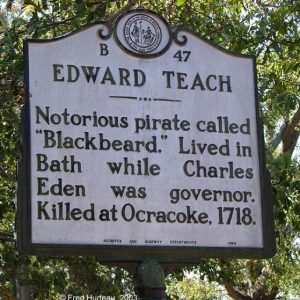
Hmm… not exactly. While the Adam Fletcher stories are often inspired by things that I happen to know about 18th century North Carolina, the only things in the book based on real life versus fiction is when I refer to actual historical characters, like Blackbeard, for instance.

What’s the deal with you and pirates? You seem to be really into them.  

Image from CarolinaOuterBanks.com

Well, to be fair, I’m not into all pirates. I’m mostly just into the history surrounding Blackbeard and other pirates with a connection to eastern North Carolina. My fascination with it springs out of the fact that I know that so many of Blackbeard’s men were actually from North Carolina and they had real families and they left records behind so we know who they are. You never hear about that when you hear the fictional Blackbeard stories. For instance, not many people know that one of Blackbeard’s men, Edward Salter, after leaving his life of piracy behind him, raised a family and was one of the founding members of St. Thomas Church in Bath ” the oldest surviving church in North Carolina.

Also, I think Blackbeard and his men have gotten a bad rap. Evidence points to the fact that they weren’t nearly as bloodthirsty and violent as they are reputed to be and some of their most infamous actions seem to have been done for the benefit of the struggling colony of North Carolina ” their home.

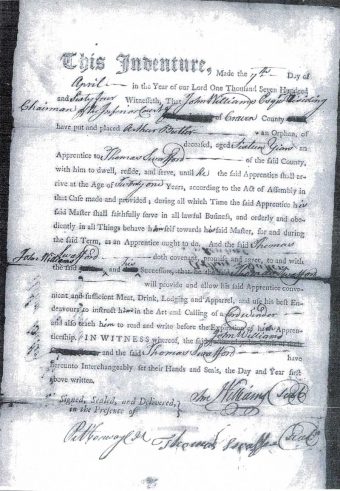
This is a copy of the apprentice bond for my 5th-great-grandfather Arthur Butler, who was bound into an apprenticeship at age 16.

I’ve always wanted to be a writer, but I don’t know what to write. How do you come up with your stories? 

Well, I think anyone who wants to be a writer has some basic thoughts about a story they want to tell ” even if it’s just an idea for one or two interesting characters, or maybe a particular genre, or time in history (or the future), or setting.

In my case, the initial idea for the Adam Fletcher series came from my fascination with the apprenticeship system in colonial North Carolina. I learned about one of my own ancestors who became an apprentice at 16, but then dealt with an abusive master. (Not very unlike the story Boaz recounts to Adam in The Smuggler’s Gambit.) I saw how in spite of my ancestor’s humble origins, he still ended up doing quite well for himself. It was a story that was begging to be told, but I realized that I shouldn’t limit myself by just turning it into a biography of my ancestor, but instead, I would make it about a fictional apprentice facing challenges head-on and overcoming all sorts of circumstances to eventually find his place in the world. That’s how Adam Fletcher came to be.

Do you have any tips for aspiring writers?

Well, my first tip is to just write the book. Don’t spend years and years and years on it, because at that point you’ve made it into this big impossible thing that will never be as perfect as you want it to be. Just write the story, hire a good editor, and publish it.

I’m not a fan of the traditional publishing industry, but that would be because I’ve always been a bit of an independent spirit, myself. I don’t like having to seek permission from anyone to write what I want to write. That said, I can offer you no advice about getting agents or securing a contract with a traditional publisher.

On the other hand, if you want to get busy with the nuts and bolts of your story, I have a whole section on my author blog dedicated to advice on everything from how you can use index cards to plan out your story to, how not to get bogged down by editing as you write, to what kind of software I like to use and why. You can see everything here.

No, I don’t actually write novels on a typewriter, but still, it’s a fun image.

Do you outline your novels or do you just start writing and let things happen naturally?

I start out with index cards, then I outline, but I’m not too detailed about it. I’ve found if I try to outline everything, I end up feeling like I’ve painted myself into a corner. On the other hand, by outlining major plot points and key events, it frees me up to create transitions as I need to throughout the story. Learn more about my process here.

It bothers me that you’re a woman and yet you make the hero of your books a young man. Why would you do that? 

I love this question. My answer is likely going to be controversial, but oh well. It is what it is. Skip to the end if you want to hear about the protagonist for my next series.

I’m glad to have a chance to respond to this question. There are actually a number of reasons why I chose to write about a male protagonist in this particular adventure series.

First of all, I’ve raised my son as a single mother and I’ve homeschooled him since kindergarten. When I started writing these stories, it didn’t escape me that he might end up reading them. He would know the stories were inspired by our North Carolina history, and in fact, some of his own ancestors, so I wanted him to be able to take pride in that, and hopefully learn something from it.

Second, I’m in love with the colonial era, but I’m also in love with adventure stories ” book or film. To be perfectly honest, I don’t want to read about swashbuckling females so why would I write about them?

Frankly, I’m a sucker for a masculine hero ” especially since it seems that kind of character is getting more difficult to find in media these days ” at least well-rounded masculine heroes who aren’t just pumped up on adrenaline all the time and ready to bash in skulls while cussing up a blue streak.

I love hearing about and reading about the kind of men who are honorable, who value women’s modesty and virtue and treat them with respect. These men are determined to protect their families and loved ones, even if it means putting their own lives at risk. They not only use their minds, but they aren’t afraid to use their fists, a knife, a gun, or whatever it takes to dispatch evil men. Men were created to be protectors. Those are the kind of characters I want to read about.

Another thing, my book’s hero is going to take some physical abuse now and then, but being the kind of man he is, it never stops him from doing what he believes has to be done. I’m not a fan of watching or reading about violence against women. There’s enough of that that exists in the real world. On the other hand, I am a fan of men who have a desire to protect women. I think that’s beautiful and admirable and I want to celebrate that.

I’ll admit I don’t watch much TV and I find little that I’m interested in at the movies, but from what I have seen, so many male characters these days seem like they’ve been neutered. It’s completely unappealing to me, as a woman, and it certainly doesn’t model the kind of man that I want my son to be.

Lastly, you may be happy to know that I do have another book series featuring a female protagonist already being mapped out for when I finally do complete the Adam Fletcher Adventures. It will be a different sort of adventure series ” more focused on mystery, with a healthy dose of comedy ” and it will take place between the years of 1985 to 1997. The title character will help solve a number of mysteries like a more aggressive Miss Marple or Jessica Fletcher, but she’ll be much younger and a big fan of New Wave ” and she’ll be brainy with computers. Sounds crazy, I know, but I think it will be fun.

Ok! I think that covers most of the questions that I get asked most frequently. If you have any others, feel free to comment on Facebook or send a message here.

Q & A with Courtney Andersen, Historic Ship Rigging Expert (and the guy, who in my opinion, helped Capt. Jack Sparrow look cool)

Courtney Andersen and Johnny Depp

Courtney Andersen is the Historic Ship Rigging Supervisor at San Francisco Maritime National Historical Park, but in addition to that, he’s also had some pretty cool gigs working on some projects you will definitely recognize (that picture with Capt. Jack Sparrow is a hint…). I’m also thrilled to report that Andersen has agreed to be a historic ships consultant for the Adam Fletcher Series. His first turn at providing advice for that has been for the soon-to-be-released fifth book in the series, The Stolen Bride. 

Tell me a little bit about yourself. Where are you from originally?

I was born in Minnesota but moved down south when I was seven, first to the Gulf Coast of Mississippi, then Florida, Savannah, and back to Florida. I was always around water. When we lived in Minnesota my mom would take me down to the Mississippi River. We drove down to New Orleans following the Great River Road each year. We always stayed in Hannibal, Missouri on those trips, because I was fascinated with Tom Sawyer. I read Tom Sawyer, and Huckleberry Finn, and Twain’s Life on the Mississippi by the time I was nine.

Like Tom and Huck, I hoped that I could grow up to be a pirate.

What got you interested in ships and maritime history?

Living on the Gulf, and going to New Orleans, one of my first heroes was Jean Laffitte, the “pirate of Barataria”. By the time I was living in Savannah (where there is a great old restaurant and bar called The Pirate’s House, with underground tunnels that lead down to the riverfront for shanghaiing sailors) I was reading lots of pirate and sailing ship history. It was really exciting to live in places where some of the events took place. New Orleans and old Savannah gave me a real appreciation for historical buildings and the atmosphere they give, walking through old cobblestone streets that haven’t changed much in 200 years.

I went to the University of Miami in Coral Gables, Florida, originally to be a marine biologist. The replica of the Bounty from the 1965 movie Mutiny on the Bounty was docked in Miami, and I went aboard and begged for a job. I was a tour guide. The ship went out for cruises on occasion around the harbor, and being aboard her during those trips was a wonderful experience.

Eventually I started helping out the rigger on board, tending lines for him and eventually going aloft on the masts to assist. He taught me to splice rope. After work, I’d go to the library at the University, and read books like Darcy Lever’s Young Sea Officer’s Sheet Anchor, a guide for rigging a sailing ship step by step that was written in the early 1800’s, then compare what I had read with what was on the ship the next day.

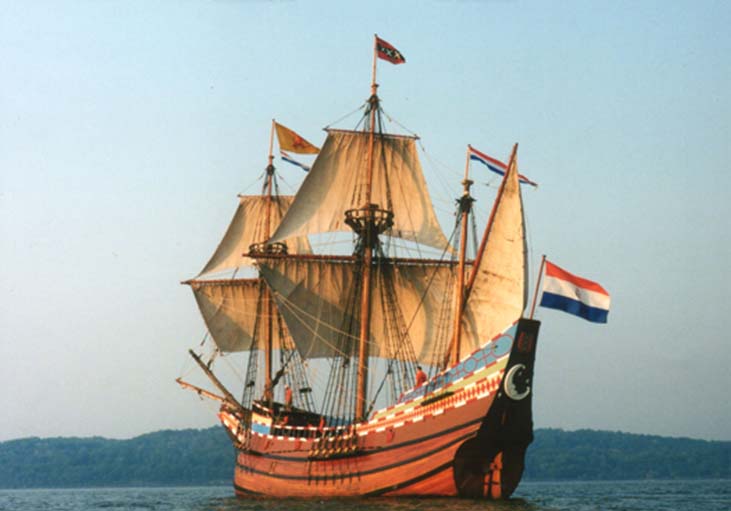
The Half Moon (d’Halve Maen)

Since then, rigging has always fascinated me. I spent the summer of 1991 sailing on Bounty from Miami up to New England, travelling from port to port in New York, Rhode Island, Massachusetts, and Connecticut. A few years later, I started working on the replica of the Half Moon (d’Halve Maen), a recreation of Henry Hudson’s Dutch ship of exploration of 1609.

I worked with another ship rigger and honed my skills that first winter. I became the boatswain and occasionally mate on board, in charge of rigging up the ship in the spring, getting sails and yards and topmasts up, directing the crew in all their work, organizing raising and setting the anchor, handling the small boat, dealing with engine and generator problems, painting, varnishing, and bringing down all the yards and sails and gear for the winter. I did that work for seven years, and also spent a lot of time researching Dutch rigging of the 17th century, in museums in the US, Britain, and the Netherlands. There is always more to learn.

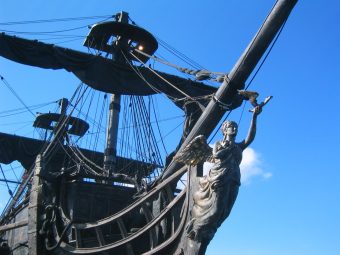
The Black Pearl

You mentioned to me that you’ve been involved with the beloved Pirates of the Caribbean movies. How did you wind up working on those?

One day, completely out of the blue, I received a phone call that I thought at first was a prank. The guy on the other end said he was calling from Disney, that they were doing a movie based on the Pirates of the Caribbean theme park ride, and they needed a rigger to design and build the sailing ship rigs. They had asked around, and my name came up a couple of times.

At first I said no, I wasn’t interested. They asked if I could come out to LA for a couple of weeks to get them going in the right direction, which I agreed to do. It was so much fun and so full of creativity and energy that I stayed to do the whole film. I had worked for a couple of weeks the year before on Master and Commander, working for a friend of mine; from that experience I learned a lot of what to do and what not to do in transferring traditional rigging to the world of movies.

What was your job on the film?

I worked for the Art Department. They gave me drawings of the ship hulls that they wanted to use, with all the decoration and elements that make the Black Pearl so unique, for instance. I took the time period and style and nationality of vessel, and drew up a rigging plan based on those criteria, with everything in the proper proportion.

The Art Director and Production Designer and Director would look at the plans, give me their feedback, and then I’d prepare a budget for what building the rig was going to cost. I hired a crew of four riggers, mostly friends of mine from other ships, and we set to work in LA, first building the Dauntless (basically a 3/4 scale HMS Victory), then the Black Pearl on stage.

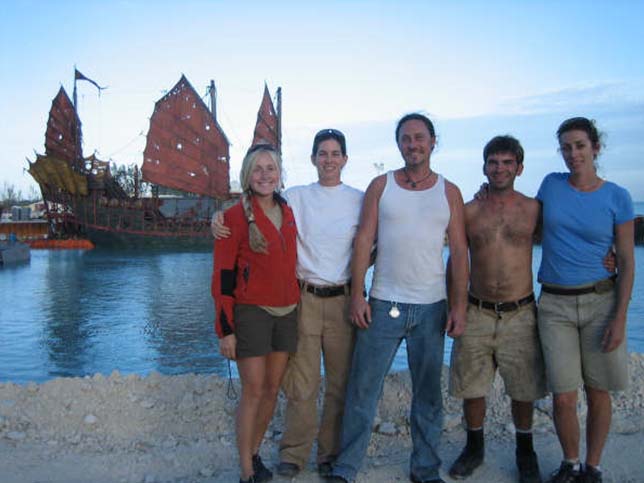
Andersen with his rigging crew stand in front of the Empress from POTC: At World’s End

We flew down to St Vincent in the Caribbean and built another Black Pearl, as well as all sorts of other boats and ships and parts of ships, for masts that fall and cross between ships, set dressing pieces and special effects gags.

Ok… In my mind, I now know that you’re the guy responsible for helping perfect the scene that made Capt. Jack Sparrow look so cool ” right off the bat ” in the first POTC film. Tell us about that. 

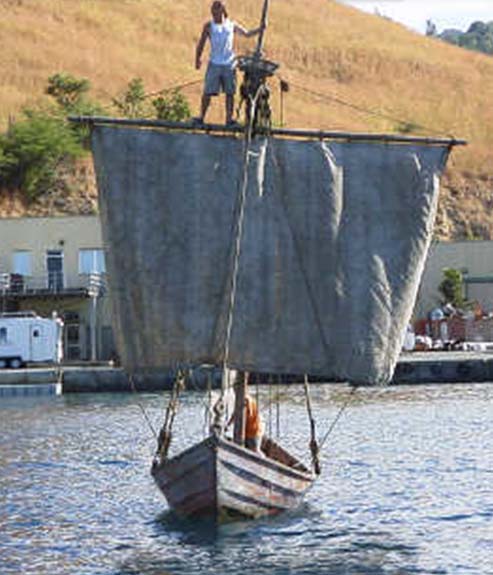
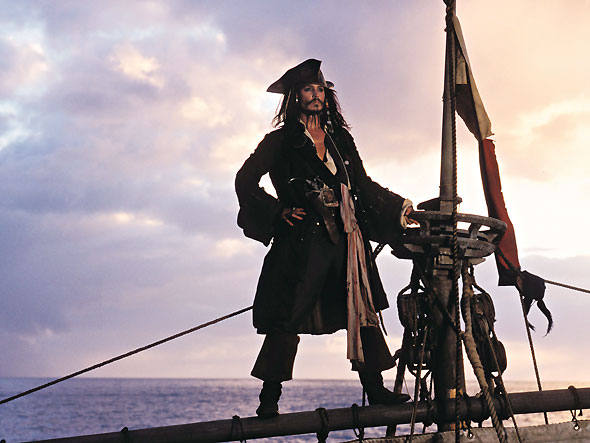
One day the Art Director asked me how tall I was and what I weighed. When I told him, he looked at me and said, “Yeah, that’s what Johnny [Depp] says too.” He told me to go meet with Special Effects out at the set and work with them on the sinking boat gag. Yes, I was the guinea pig for perfecting the great scene in the movie when Capt. Jack stands on the yard of the little boat (we called it the Jolly Mon) and it sinks under him, timing it perfectly for him to step off and right onto the dock.

Andersen helps perfect the scene that made Johnny Depp look so cool as Jack Sparrow.
Once Courtney Andersen perfected it, Johnny Depp acted out this iconic scene in Pirates of the Caribbean: Curse of the Black Pearl [Google images]

I must have done that ride a dozen times before it stopped falling over and dunking me in the water. Finally on the first day I met Johnny Depp on set, he stood on the dock and I stood on the yard of the little boat, and he watched me ride it down and step off onto the dock next to him. I helped him get on the yard of the boat and showed him what to hold on to, and then he did the stunt ” with a bit more flair than I had done.

Without a doubt, that is one of the most memorable scenes in any of those movies, so let me just say, “Well done, sir.” What other sorts of things did you end up doing?

One of the main jobs I had on the movies when we were shooting was to stay close to the director on set; he would say “Can that rope move?” or “Can you show those actors how to haul a line?” or “What jobs would the background people do?” Basically, I’d be there to work with any part of the rig for whatever the director wanted to see, and give suggestions to the actors for “shippy” things to do.

This is something you don’t see in the movies ” the cutaway view of the port side of the HMS Dauntless from POTC

The actors were all around there as well (think of the director’s chairs set up with everyone’s name on them…that’s really what they are for), and everyone was very friendly. Johnny would ask questions about what it was like to sail on an old sailing ship, or talk about missing his kids, or we would commiserate about getting the runs from the food at the restaurant we had both happened to eat at the night before.

How many films in the series did you work on on? And did your work on the films allow you to meet or work with any of the other principle actors or production staff?

I ended up working on all five of the Pirates movies, and working with the actors and crews were like a family.

Mostly the same people worked on the first three movies, with fewer doing the 4th. By the time we did the 5th, there was just a handful of the crew who had done the others. Johnny Depp, Geoffrey Rush [Capt. Barbossa], and the two who played Murtogg and Mulroy, the Marines-turned-pirate, were all there, and it was great to see and hang out with them again.

Have you worked on any other films since then?

That movie work led to other jobs, doing rigging design for motion pictures: National Treasure, Voyage of the Dawn Treader, 12 Years a Slave, as well as some that never made it to production. Oh, and J.J. Abrams’ Star Trek.

I know your career in historic ship rigging has been about a lot more than just film work. What other projects have you been especially proud of?

Some other projects I’ve been a part of include pulling the masts of the Golden Hinde replica in London, to get them in shape for the Queen’s Jubilee a few years ago…that was pretty awesome, to be on the Thames, working on the Golden Hinde (the original was sailed under the first Queen Elizabeth).

I am scheduled to do some rigging overhaul on the Nonsuch, a replica of a 1650’s vessel which is inside the Manitoba Museum. This month, I am building new shrouds for the USS Maine Memorial at Arlington National Cemetery as part of the restoration of the memorial to the ship and crew blown up in Havana harbor in 1898.

Andersen spent six years researching and designing the rig for the restoration of the lumber schooner C.A. Thayer. Here she is at Gray’s Harbor in 1903. (NPS Photo, SAFR E3.8495n)

I work full time at the San Francisco Maritime National Historical Park as the Historic Ship Rigging Supervisor. We just sent our 1886 steel sailing ship Balclutha to dry dock, and are going to continue rigging the 1895 West Coast lumber schooner C.A. Thayer. I spent nearly six years researching and designing her rig, to return her to what she looked like when she was first launched.

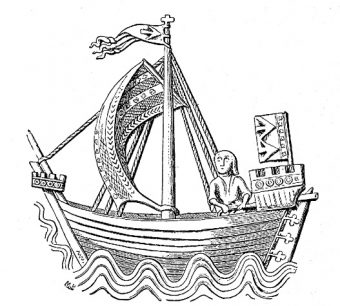
Illustration of cog (Wikipedia)

What is your favorite era of maritime history, or what era fascinates you the most?

I really love the whole range of the age of sail, from the 1500’s and the ships of exploration and colonization right up through the Victorian period as sail gave way to steam. I just built a model of a little “cog” from the 1400’s, so I did a bunch of research on those late medieval ships and sailors. It’s fascinating to see how vessels evolved, and how the techniques of navigation and rigging and shipbuilding developed and allowed people to sail further and further. There’s a romance about the sea, and getting away from land.

Was ship construction and sailing much different between, say, the Golden Age of Piracy and the period of the Adam Fletcher books (1760s)? And now that I think about it, what about the Roanoke Voyages/Jamestown era versus the GAoP?

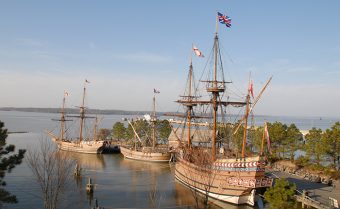
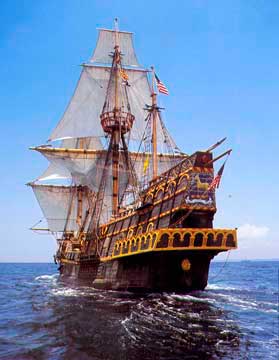
Ships like those at Jamestown or Manteo are really the same as the Golden Hinde and Half Moon and San Salvador and even Kalmar Nyckel or Batavia. That’s a span of about a hundred years, from the early 1500’s to the early 1600’s. There were some changes after the late 1600’s, such as the introduction of the ship’s wheel, and the phasing out of the spritsail topmast, and the lowering of the high poop and forecastle.

The Discovery, the Godspeed, and the Susan Constant reproductions from Jamestown 1607 voyage
The Golden Hinde

Rigging lines evolved a little, but really, sails and ships were handled the same way they had been from the 1400’s through the early 1900’s. Masts got taller and as they did, additional sails were added. But a sailor from Columbus’ day would recognize every line on the Balclutha here at SF Maritime.

Chapelle’s History of American Sailing Ships has some good info for the 1760’s on the types of vessels around American waters, including ships, sloops, pinks, brigantines, shallops, ketches, barks, and schooners. He says that the bulk of the vessels were small, and mostly sloops from 25 to 70 tons, then brigantines from 20 to 150 tons. The book has some excellent plans and illustrations that show the size of these vessels.

Another excellent book is The Colonial Schooner 1763-1775 by Harold M. Hahn, with illustrations and photos of a model of the schooner Halifax, showing people working aboard and down in the hold. It gives a good idea of the scale of these small work vessels.

I think you mentioned to me you’ve been to Beaufort. Do you have any special insight you can offer into sailing and shipping on the North Carolina coast during that pre-Revolution period?

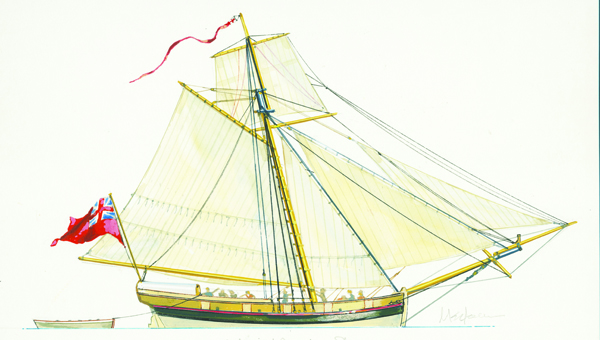
So, in Adam Fletcher’s day, you’d see ships still with a slightly raised quarterdeck and foredeck but possibly only a couple of steps up a ladder, not necessarily a full head-height cabin area; all the rigging would still be tarred hemp ”not manilla ” with very little metalwork used beyond hooks and chainplates, everything else was wood. Ships and boats in the Colonies were already showing some variations from their European roots. There were fast vessels being made, variously called “Bermuda” or “Jamaica” sloops, as well as the occasional three-masted ship.

Jamaica-rigged sloop Adventure (Painting by Melbourne Smith, commissioned by the Blackbeard Adventure Alliance)

It’s important to remember that true ships, larger three-masted vessels, were not nearly as common around the Colonial ports as smaller vessels, schooners, brigs, sloops, cutters, and even smaller boats. These were the primary coastal trading vessels; ships were more reserved for trans-oceanic commerce. That being said, even the sloops and schooners of 50′ or so would be sailed to the Caribbean and even farther.

There would likely have been a lot of vessels in the 35-55 foot range which had shallow enough draft to get over sandbars in the Outer Banks and up creeks, and large enough to go out the inlets to travel down to Savannah or Charleston, and up to Jamestown and Yorktown, Hampton Roads, Baltimore, Philadelphia, New York, Connecticut, and Boston. Harbors were full of small boats, rowboats and little sprit or gaff rigged boats to ferry a couple of people from ship to shore or sell goods on a very small scale, or to ferry people across rivers or small bays, or engaged in fishing.

Small vessels called “lighters” were often used for offloading the cargo of a larger vessel if it couldn’t get to a dock or if the port had shallow water and the cargo vessel had to anchor out.

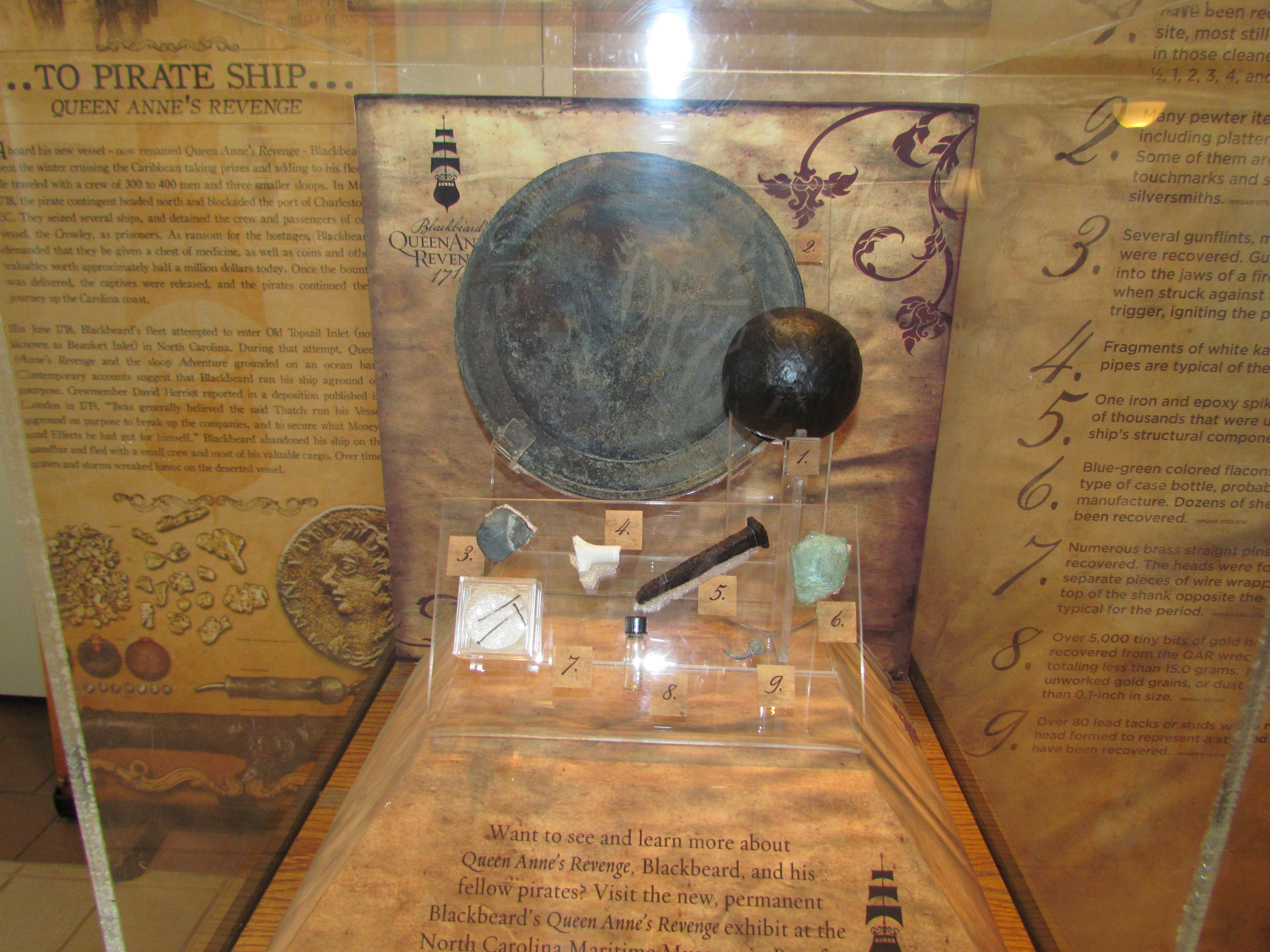
A ship believed to be the Queen Anne’s Revenge was found off the coast of Beaufort in 1996 by Intersal, Inc. Since that time, the research community has concluded that the wreckage found was, indeed, the infamous Blackbeard’s vessel. This picture is from the exhibit at the NC Maritime Museum in Beaufort.

Some folks may know that the infamous Blackbeard ran one of his pirated ships, the frigate Queen Anne’s Revenge, aground near Beaufort Inlet. Based on what we know about the QAR‘s characteristics, would a ship like that have been able to sail in Taylor Creek, or would the water have been too shallow?

Taylor’s Creek channel today is a depth of 8.5 to 9 feet, which would have been about touching bottom for Queen Anne’s Revenge; besides, Taylor Creek is a very narrow waterway. A ship like QAR wouldn’t sail in there. They could have kedged their way up, rowing out anchors ahead of the ship and using the capstan to haul themselves up, but it would have been more likely QAR was heading either just behind Shackleford Banks or Bogue Banks, both of those have fairly decent “tongues” of deeper water behind them, which could have provided anchorages ” of course, I’m looking at a modern chart, and trying to see if there are natural deep waters aside from the dredged channels. But remember, the theory is that Blackbeard intentionally had QAR run aground to disable her and disband his crew, so it seems he was intimately familiar with those waters, and knew right where to do it.

Regarding pirate “ships,” generally speaking, large ships of over 150 tons were not as commonly used by pirates ” so the Black Pearl is a bit misleading! Ships that size are less maneuverable, and need deeper water.

Pirates liked to be able to duck into shallow areas ” like behind the Outer Banks ” to avoid detection by larger Navy vessels. Those Bermuda sloops were ideal, being fast, yet still capable of being ocean-going. Pirates would cram them full of guns and carry sometimes 60 or 100 men on those small vessels. Blackbeard had one, called Adventure, also the name of many pirates vessels ” they didn’t seem to be very creative when it came to names. He ran aground even in that, as did the Navy sloop hunting him down, during Blackbeard’s final battle off Ocracoke.

Many pirates started out with just a few pirogues, basically low rowboats, for surprising their victims at night and taking over the ship before the crews knew what was happening.

I believe there is a Blackbeard story about an attack from a pirogue near Bath. [See his victim’s deposition in the NC Colonial Records.] They are related to the periaugers or perogues, which were sometimes a bit larger and carried sails, but the names are so similar and spelling was not very standardized, so it can be difficult to be sure which type of boat is really being talked about. The perogues in the south tended to be made canoe-fashion, from solid tree trunks, and big enough to carry thirty or more barrels of goods.

[Below is a short video on a colonial-style periauger that was constructed in North Carolina.]

Everybody who knows me knows I’m a massive history nerd. I’m also a huge fan of the POTC movies, so it made my day when I learned you were a fan of the Adam Fletcher novels! I guess I should ask at least one question about your thoughts on the series. Who is your favorite character and why?

Aside from Adam Fletcher, I really like several of your characters. Emmanuel has some great stories in his past. I’d love to read at some point about all Blackbeard’s old crew having one last adventure together.

In addition to Adam and Emmanuel, one of Andersen’s favorite AFAS characters is Aunt Celie in Murder in the Marsh.

But of course I am most intrigued by Rocksolanah “Laney” Martin! I’m interested to see where her relationship with Adam goes. Growing up in the south, I am also fond of Aunt Celie in Murder in the Marsh. I appreciate the characterization of her being a maternal figure, watching out for Laney and the Martin household, and I thought it was pretty sensitive the way you addressed her fear of the thought of “freedom.” Not to justify or excuse slavery, or to suggest that it was all a happy situation all around, but that scene really gave an insight into how it must have felt to be taken from your home to a completely different environment, and be somewhat adjusted to it, then be given the option of freedom and having to sort out your own way in that strange world.


The iconic bowsprit of the Black Pearl
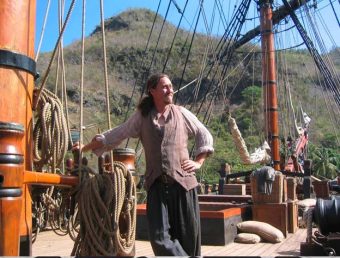
Andersen as extra on the replica of Bounty his team hired for POTC2/3 down in St Vincent. She played the Edinburgh Trader that gets broken in half by the kraken!
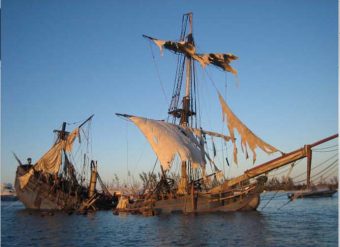
Andersen says, “[This] is a great example of movies recycling props and sets. This started out as the replica we built of Bounty to break in two for the kraken attack (they didn’t want to break the real ship!), and then the pieces got repositioned and we put on different sails and shredded them. This became the ship Will is sent to by Jack to meet Davy Jones. I think we then used pieces of it for mast “crows nest” sets as well, and eventually blew them up for a battle scene.
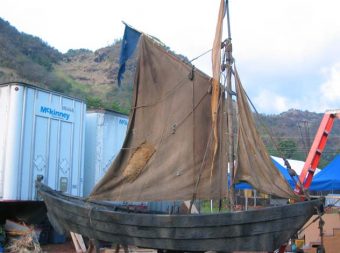
This is the little boat Jack ends up in POTC 3, after Barbossa steals the Pearl. It also appears in one of the scenes at the dock.
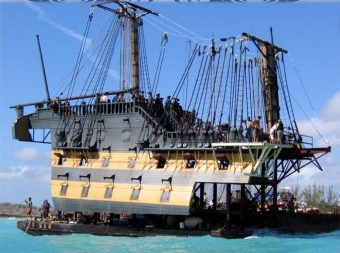
One of the many versions of Endeavor we made for POTC2/3. According to Andersen, it was basically the same ship as Dauntless, which was a 3/4 scale version of the real HMS Victory in England.

[All images courtesy of Courtney Andersen unless otherwise noted.]

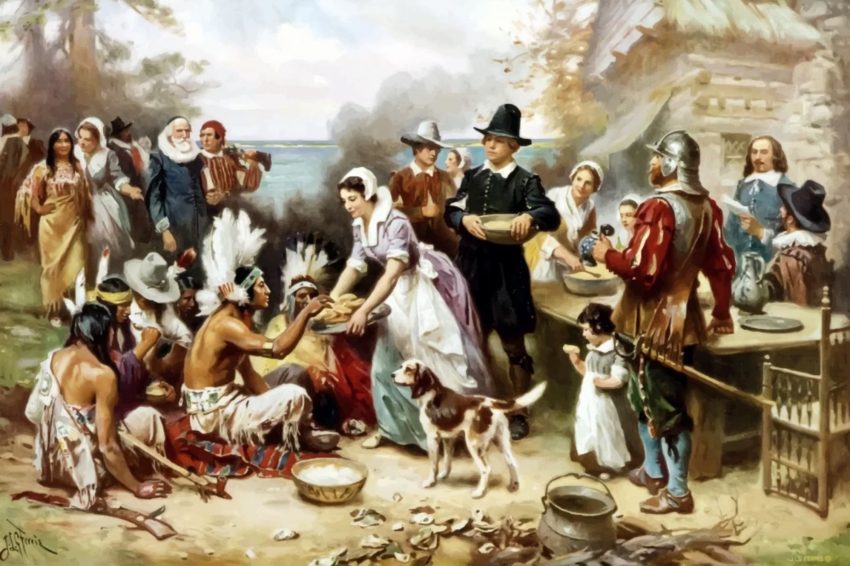
George Washington’s Thanksgiving Proclamation of 1789

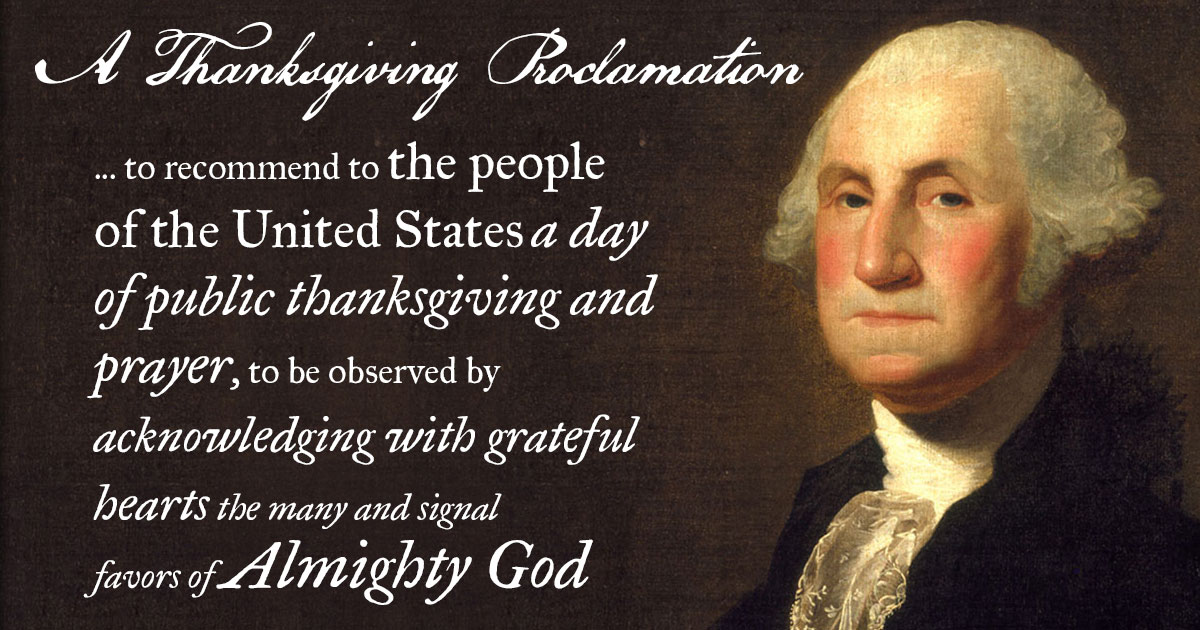
George Washington's Thanksgiving Proclamation

While there are revisionist historians who awkwardly perform intellectual somersaults and contortions to construct fictional narratives about our nation’s history, insisting that its foundations are wholly secular, the plain fact is that the United States of America was”without question, debate, or doubt”established as a “nation under God.”

A clear sense of Biblical ethics infused every aspect of American Colonial life and the Founders would have never imagined it possible to establish and maintain a successful Republic that does not keep its eyes fixed on God and its moral framework grounded in the Scriptures.

In fact, it was of such importance to our Founding Fathers to acknowledge God ” the Author and Creator of all things ” and His Divine Providence that allowed this country to come into existence, that even our very first president, George Washington, “at the request of Congress,” issued the following:

Thanksgiving Proclamation

Issued by President George Washington, at the request of Congress, on October 3, 1789

By the President of the United States of America, a Proclamation.

Whereas it is the duty of all nations to acknowledge the providence of Almighty God, to obey His will, to be grateful for His benefits, and humbly to implore His protection and favor; and”Whereas both Houses of Congress have, by their joint committee, requested me œto recommend to the people of the United States a day of public thanksgiving and prayer, to be observed by acknowledging with grateful hearts the many and signal favors of Almighty God, especially by affording them an opportunity peaceably to establish a form of government for their safety and happiness:

Now, therefore, I do recommend and assign Thursday, the 26th day of November next, to be devoted by the people of these States to the service of that great and glorious Being who is the beneficent author of all the good that was, that is, or that will be; that we may then all unite in rendering unto Him our sincere and humble thanks for His kind care and protection of the people of this country previous to their becoming a nation; for the signal and manifold mercies and the favor, able interpositions of His providence in the course and conclusion of the late war; for the great degree of tranquillity, union, and plenty which we have since enjoyed; for the peaceable and rational manner in which we have been enabled to establish constitutions of government for our safety and happiness, and particularly the national one now lately instituted; for the civil and religious liberty with which we are blessed, and the means we have of acquiring and diffusing useful knowledge; and, in general, for all the great and various favors which He has been pleased to confer upon us.

And also that we may then unite in most humbly offering our prayers and supplications to the great Lord and Ruler of Nations, and beseech Him to pardon our national and other trangressions; to enable us all, whether in public or private stations, to perform our several and relative duties properly and punctually; to render our National Government a blessing to all the people by constantly being a Government of wise, just, and constitutional laws, discreetly and faithfully executed and obeyed; to protect and guide all sovereigns and nations (especially such as have shown kindness to us), and to bless them with good governments, peace, and concord; to promote the knowledge and practice of true religion and virtue, and the increase of science among them and us; and, generally, to grant unto all mankind such a degree of temporal prosperity as He alone knows to be best.

Given under my hand at the City of New York the third day of October in the year of our Lord 1789.

Go. Washington

For a brief history of the Reformed Theologians who first began this day of Thanksgiving in America and who, in fact, helped shape our Constitutional Republic, please enjoy this thorough article by Mark David Hall at The Federalist.

Thanksgiving


Originally published November 20, 2015. Updated November 26, 2020.

Next Page »

Primary Sidebar

Please note: All links to vendor sites are provided as part of an affiliate program.

About the Author

Sara Whitford's third-great-grandfather, William Morris, wrote their family lineage in a worn old copy of Robinson Crusoe. Adventure, literature, and history are in her blood. Ever since she can remember, she has been fascinated by the intriguing past of the coastal North Carolina region that has been home to her … Read more about About the Author