• Skip to primary navigation
  • Skip to main content

Adam Fletcher Adventure Series

Bestselling, family-friendly historical fiction set on the colonial North Carolina coast

  • Book 1
  • Book 2
  • Book 3
  • Book 4
  • Book 5
  • Book 6
  • Book 7

Sara Whitford

The Real Blackbeard: Get ready to have everything you thought you knew turned on its head

Kevin Duffus is the author of The Last Days of Black Beard the Pirate and is NC Historian of the Year for 2015

In The Smuggler’s Gambit, one of the characters turns out to have a history with the pirate Blackbeard. As he recounts the experiences of his youth, he tells a different story than what legends and myths have had many of us believe over the years.

I credit my good friend, Kevin Duffus, author of The Last Days of Black Beard the Pirate and North Carolina Historian of the Year (2015), with his ground-breaking research on the most famous pirate who ever lived. If you have an hour, you’ll learn in this video that everything you thought you knew about Blackbeard is wrong.

Here are just a few highlights from the lecture:

  • Blackbeard was not middle-aged when he was killed in his final battle with Lt. Maynard. In fact, he was probably only about 28 years old.
  • None of the artistic impressions (woodcuts, portraits, etc.) of Blackbeard are based on any eyewitness accounts.
  • Blackbeard’s real name wasn’t Edward Teach or Edward Thache, or anything of the sort.
  • Blackbeard’s greatest treasure wasn’t gold. Do you know what it was? This video will tell you.

What’s Wrong with Black Beard? by Kevin P. Duffus (Video) from Virginia Historical Society on Vimeo.


(Originally published May 15, 2015.)
Massachusetts Circular Letter (Originally written by Samuel Adams and James Otis, Jr. and passed by the Massachusetts House of Representatives)

Circular letter from the Massachusetts House of Representatives to the provincial legislatures in America

Massachusetts. General Court
February 11, 1768

From The Colonial Records of North Carolina, Volume 07, Pages 686-689


[From MS. Records in Office of Secretary of State.]

Province of the Massachusetts-Bay, Feby 11th 1768.

Sir [to the Speaker of the House of Assembly.]

The House of Representatives of this Province have taken into their serious Consideration, the great Difficulties that must accrue to themselves and their constituents, by the Operation of the several Acts of Parliament imposing Duties and Taxes on the American Colonies.

As it is a Subject in which every Colony is deeply interested, they have no Reason to doubt but your Assembly is duly impressed with its Importance; and that such constitutional measures will be taken by them as are proper.

It seems to be necessary, that all possible Care should be taken that the Representations of the several Assemblies upon so delicate a Point should harmonize with each other: The House therefore hope that this Letter will be candidly considered in no other Light, than as expressing a Disposition freely to communicate their mind to a Sister Colony, upon a common Concern, in the same manner, as they would be glad to receive the Sentiments of you or any other House of Assembly on the Continent.

This House have humbly represented to the Ministry their own Sentiments, that his Majesty’s high Court of Parliament is the supreme legislative Power, over the whole Empire: That in all free States the Constitution is fixed; and as the supreme Legislative derives its Power and authority from the Constitution, it cannot overleap the Bounds of it without destroying its own Foundation: That the Constitution ascertains and limits both Sovereignty and Allegiance; and therefore his Majesty’s American Subjects who acknowledge themselves bound by the Ties of Allegiance, have an

——————– page 687 ——————–

equitable Claim to the full Enjoyment of the fundamental Rights of the British Constitution: That it is an essential unalterable Right in Nature, ingrafted into the British Constitution, as a fundamental Law, and ever held sacred and irrevocable, by the Subjects within the Realm, that what a man has honestly acquired is absolutely his own, which he may freely give, but cannot be taken from him without his Consent: That the American Subjects may therefore, exclusive of any Consideration of Charter Rights, with a decent Firmness adapted to the Character of Freemen and Subjects assert their natural constitutional Rights.

It is moreover their humble Opinion, which they express with the greatest Deference to the Wisdom of the Parliament, that the acts made there, imposing Duties on the People of this Province, with the sole and express Purpose of raising a Revenue, are Infringments of their natural Constitutional Rights, because as they are not represented in the British Parliament, his Majesty’s Commons in Britain by those Acts grant their Property without their Consent.

This House further are of Opinion, that their Constituents, considering their local Circumstances, cannot by any Possibility be represented in the Parliament; and that it will for ever be impracticable that they should be equally represented there, and consequently not at all; being separated by an Ocean of thousand Leagues: and that his Majesty’s royal Predecessors were graciously pleased for this Reason to form a subordinate Legislature here, that their Subjects might enjoy the unalienable Right of a Representation; and that considering the utter Impracticability of their being fully and equally represented in Parliament, and the great Expense that must unavoidably attend even a partial Representation there, this House think that a Taxation of their Constituents, even without their Consent, grievous as it is, would be preferable to any Representation that could be admitted for them there.

Upon these Principles, and also considering that were the Right in the Parliament ever so clear, yet for obvious Reasons it would be beyond the Rules of Equity that their Constituents should be taxed on the manufactures of Great Britain here, in addition to the Duties they pay for them in England, and other advantages, arising to Great Britain from the acts of Trade, this House have preferred a humble, dutiful and loyal Petition to our most gracious Sovereign, and made such Representations to his Majesty’s Ministry, as they apprehended would tend to obtain Redress.

——————– page 688 ——————–

They have also submitted it to Consideration, Whatever any People can be said to enjoy any Degree of Freedom, if the Crown in Addition to its undoubted Authority of constituting a Governor, should also appoint him such a Stipend, as it shall judge proper without the Consent of the People, and at their Expence; and whether while the Judges of the Land, and other civil officers in the Province hold not their Commission during good Behavior, their having Salaries appointed for them by the Crown, independent of the People, hath not a Tendency to subvert the Principles of Equity, and endanger the Happiness and Security of the Subject.

In addition to these measures, the House have wrote a Letter to their Agent Mr Deberdt, the Sentiments of which he is desired to lay before the Ministry, wherein they take notice of the Hardships of the Act for preventing Mutiny and Desertion, which requires the Governor and Council to provide enumerated articles for the King’s marching Troops, and the People to pay the Expence; and also of the Commission of the Gentlemen appointed Commissioners of the Customs to reside in America; which authorizes them to make as many appointments, as they think fit, and to pay the appointees what Terms they please; for whose mal conduct they are not accountable from whence it may happen that Officers of the Crown may be multiplied to such a Degree as to become dangerous to the Liberties of the People, by virtue of a Commission which doth not appear to this House to derive any such advantages to Trade, as many have been led to expect.

These are the Sentiments and Proceedings of this House and as they have too much Reason to believe that the authorities of the Colonies have represented them to his Majesty’s Government and the Parliament as factious, disloyal and having a desire to make themselves independent of the Mother Country, they have taken Occasion in the most humble Terms to assure his Majesty and his Ministers, that with regard to the People of this Province, and as they doubt not of all the Colonies, the Charge is unjust.

The House is fully satisfied, that your Assembly is too generous and enlarged in Sentiment, to believe, that this Letter proceeds from an Ambition of taking the Lead or dictating to the other Assemblies: They freely submit their opinion to the Judgment of others, and shall take it kind in your House to point out to them any Thing further which may be thought necessary.

——————– page 689 ——————–

This House cannot conclude without expressing their firm Confidence in the King, our common Head and Father, that the united and dutiful Supplications of his distressed American Subjects, will meet with his royal and favorable acceptance.

In the Name and by Order of the House of Representatives
I am, Sir, with Respect
Your most humble Servant,
THOMAS CUSHING Speaker
Received April 1st 1768.

For further reading:

Massachusetts Circular Letter at NCPedia (https://www.ncpedia.org/massachusetts-circular-letter)

Correspondence of Governor William Tryon (http://digital.ncdcr.gov/cdm/ref/collection/p249901coll22/id/413146)

Samuel Adams, the Sugar Act, and Taxation (https://www.sarawhitford.com/samuel-adams-on-the-sugar-act-or-taxes-then-and-now/)

What is the truth about the Lost Colony? – New insight into America’s oldest “mystery”

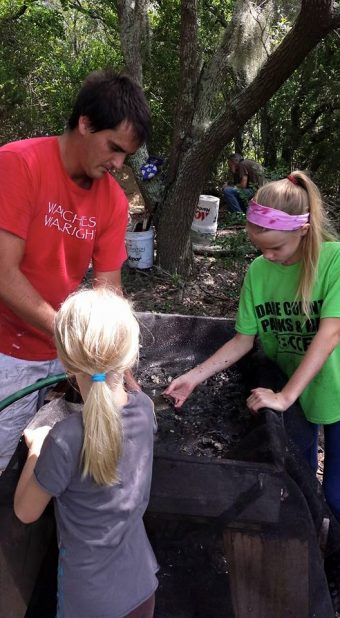
Scott Dawson in the field showing his daughters how to do archaeology.

This isn’t an article about Adam Fletcher. And it isn’t even an article about Colonial Beaufort, or even Colonial America.

This is about something that goes back even earlier…

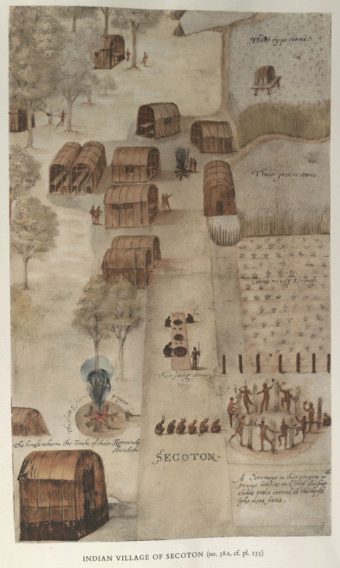
Recently, more than one television documentary has offered viewing audiences one spin after another about one of America’s favorite historical mysteries–the Lost Colony. Through my work with Coastal Carolina Indian Center, as well as my own roots in the region that go back to the earliest colonists and the Algonquian peoples of the coast, I have always had a particular interest in the Lost Colony, but also the other Roanoke expeditions as well. (Yes, there were others.) It was in those expeditions that Thomas Harriot recorded his experiences with the first indigenous Americans who ever encountered the English. It was during those same expeditions that John White created the beautiful watercolor illustrations that give us a glimpse of what life was like in America in the 1580s.

When one has a personal connection to a certain history, it tends to inspire a great passion about it. That seems to certainly be the case with Scott Dawson, who along with his wife, Maggie, founded the Croatoan Archaeological Society. I’ve known Scott for years. He has contributed articles and materials to our CCIC website. Earlier this week I interviewed him about recent discoveries related to the Lost Colony and the related Roanoke expeditions, as well as what his organization is doing to help uncover a fuller picture of the history.

Q – A lot of news articles and documentaries have been coming out over the last year relating to the Lost Colony. In fact, I understand there was one on the History Channel recently that talked about the Dare Stones. What do you know about that?

A – I was on the History Channel a few years ago and they were doing a show about the Dare Stones, but they never told me that was what the show was about. When they contacted me they said it was about the “lost colony” and they were interested in the archaeology we had been doing in Hatteras. I had no idea it was a quack show or I would have never agreed to go on it.

The Dare Stones are a hoax, as any reasonable person can tell. The first stone was found the year the Lost Colony play came out in 1937. When that play began, it created the mystery of the “lost colony” to sell tickets and the public was hoodwinked into thinking it was a real mystery.

Magically, the first stone pops up and is authored by none other than a member of the Dare family, of course.

The entire area where the stone was found was excavated, but nothing was found. Later, 41 more stones were found–none of them even in the state of North Carolina–and all by just four people, which it turns out all knew each other and even tried to blackmail a professor into saying they were real.

It was put to bed as a hoax a long time ago in the 1940s, but I guess it makes good TV–so there you have it.

The idea the colony walked to the outskirts of Atlanta and left a trail of stones behind and no other artifacts is probably the dumbest of a host of stupid theories out there.

Q – The outdoor drama about the Lost Colony has been really popular over the years and is a big tourist draw. Would you say that it’s an accurate portrayal of the history?

The Lost Colony play has been a tourist draw and that is why it was created.  I don’t think the play even pretends to be accurate. Almost nothing about the play is accurate.

The very idea they are lost isn’t even accurate.

Real history from the primary sources is not ambiguous at all about the fate of the colony. The “lost” colony of 1587 was the fourth English voyage to North Carolina.

This watercolor of Secotan–an Indian village that was across Pamlico Sound from Hatteras island–was created by John White during one of the Roanoke expeditions.

The first voyage landed at Hatteras Island–then called Croatoan. This is the voyage that met Manteo–who was from Croatoan–not Roanoke. They only spent one night on Roanoke Island during the six-week stay of the first voyage. A relationship had begun with the Croatoan of Hatteras Island that continued for years.

The second voyage had English people living on BOTH Hatteras Island and Roanoke Island. The English were at war with Indians from the adjacent mainland and killed their Chief and burned one of their villages before going back to England.

The third voyage was just 15 men left on Roanoke who got attacked by the mainland Indians.

The fourth voyage was the one known as the Lost Colony and they were only stopping by to get the 15 men from the year before, only to discover they had been killed.

The Lost Colony also had a man, George Howe, [who was] killed in 1587 by mainland Indians. When this happened, they sent 20 men with Manteo to his home, Hatteras, to get help. They were hosted to a feast and told that the Croatoan of Hatteras would try to smooth things over for the English with the mainland. Instead, they sacked a mainland village and stole all the corn and split it with the English. When the governor left and instructed the colony to carve out where they had moved to, it was no shocker that they wrote “Croatoan.” This is a tribe the English had known for years and the only tribe in the area who did not want to kill them. These are facts.

Unfortunately, if you tell the facts from the primary sources you can’t pretend the colony is lost and thus you won’t sell as many tickets.

Q – What is your connection to this history? Why is it something that you care so much about?

A – I am a history teacher in Elizabeth City and as I tell my students what matters the most is the truth. I feel like the mythology of the Lost Colony is a slap in the face to the Croatoan people.

In the real history, they fed and cared for the English and undoubtedly adopted them in the end. Yet in the mythology, they are marginalized to a strange message on a palisade and all mention of their contact with the English is swept under the rug.

Q – You have been researching this history for years and you’ve found many archaeological artifacts, right? Many of them you have found just living on Hatteras?

A – I grew up on Hatteras and my Mother’s family has lived there for at least eight generations.

We go back to the Croatoan who were still living there well into the 1750s.

There was a land grant to the Hatteras Tribe in 1751 that was signed by the colonial governor Arthur Dobbs.

My family still lives on that land, as well as many other families, most of whom have been doing so since they were wearing deerskins.

I have found thousands of pieces of pottery and other artifacts and started doing so when I was 10 years old. Now I head a non-profit group and got professionals from the University of Bristol to start doing archaeology there for the last seven years.

Anyone who knows me knows I told them exactly where the Croatoan villages were and predicted 16th century material would be in the village. So far we have located more than one Croatoan village and found several 16th century English artifacts mixed in with Croatoan exactly where I and pretty much everyone on the island has always said it would be.

Q – I’m aware that a university in England has taken interest in digging at Buxton. How did the Croatoan Archaeological Society (CAS) come to partner with an archaeology team from across the pond? And why do you think North Carolina universities haven’t gotten involved?

A – North Carolina Universities would probably love to be involved, but unfortunately, the property owners–at least most of them–do not trust them. ECU did some digs in the late 1990s and they also took artifacts that people had brought for them [back to the university] to look at and never returned them.

It is a very small community and they burned that bridge.

The University of Bristol (UoB) from England was a good choice, after all, this is their history too. We have always had American volunteers and many Americans from the University of Michigan, William and Mary and South Carolina have been involved in one way or another. In fact, our last dig was mostly Americans.

Usually the British outnumber us on these digs, but it is a great opportunity for the school kids of Hatteras to get some exposure to a different culture. The UoB students have done digs at the high school with local students and we actually found some pottery from about the year 500 behind the school.

CAS is a community organization so we work with the school and do all kinds of programs for the kids.

UoB has been wonderful. I can’t say anything but positive comments on their work ethic, professionalism and dedication. Dr. Mark Horton is the leader and when I met him in 2009, he had me pick the places to dig, secure permission, and off we went. The finds were so amazing he told me we needed to get organized and form CAS, so we did.

Q – What have been some of the most interesting finds in your excavations?

A – Everyone would answer this question differently. Obviously the English stuff from the 1500s such as a writing slate, a rapier (sword handle) and the Nuremberg token, copper bun, Elizabeth glass and all the “lost” colony stuff is at the top of the list for most.

For me it is seeing the postholes of the Croatoan longhouses and knowing exactly where their houses were. I also like the really old stuff we have found–some of the spear points are thousands of years old.

I like anything with art on it too, especially the Native pottery and some of the decorated pipes. The whole thing is amazing. It is as close to time travel as it gets.

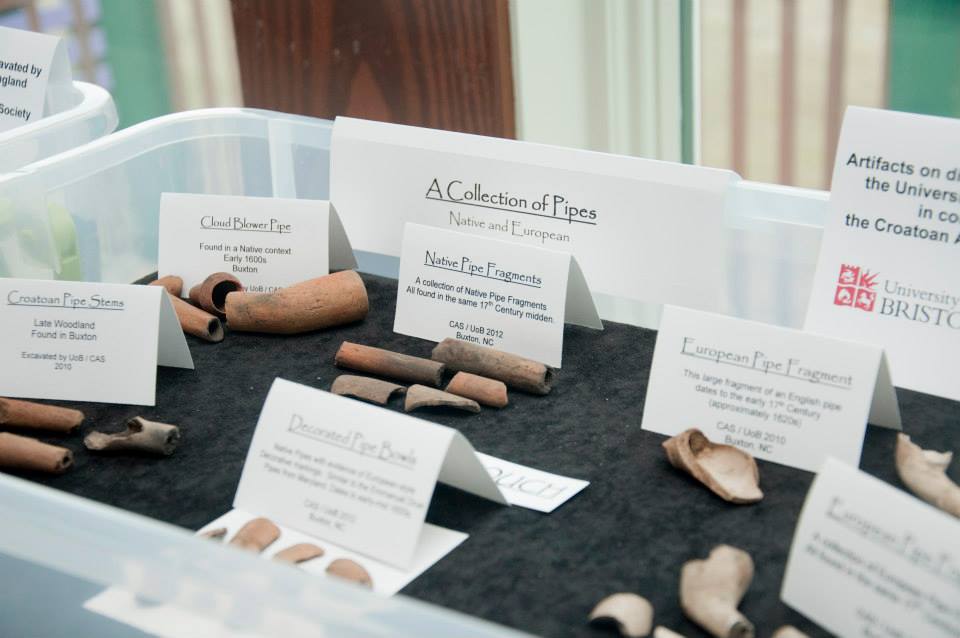
A glimpse of some of the artifacts found in excavations by Croatoan Archaeological Society and the University of Bristol

Q – What do those finds mean for interpreting the history of the so-called Lost Colony?

A – It means the “lost colony” wasn’t lost. They were abandoned and went exactly where they indicated they went with the CROATOAN message.

If anything is a mystery, it is that no one looked in the most obvious location for almost 400 years.

It goes to show how few people actually read primary sources and how much misinformation is circled around by so many so called experts.

It is sad really, because now that we have the evidence we have to deal with these competing theories that have no basis in reality like the Dare Stones, or Beechland, or Bertie.

If people would just read the historical context of the colony they would know that going inland would be like a Jewish family during World War II fleeing Poland by going to Germany! The mainland was attacking and killing the English, whereas Croatoan had been feeding and protecting them for years. Not to mention the fact the colony carved “CROATOAN” in the palisade to indicate that is where they went, and now we found their stuff there.

It’s irritating, but I think any reasonable person can understand the colony went to Croatoan if given the facts.

The London Times featured the work of the archaeological discoveries documented by Professor Mark Horton (University of Bristol - England) along with Croatoan Archaeological Society.
The London Times featured the work of the archaeological discoveries documented by Professor Mark Horton (University of Bristol – England) along with Croatoan Archaeological Society.

Q – In your opinion, what happened to the Lost Colonists? Where did they end up? Did they survive? Did they–as some have suggested–go into the sassafras business?

First of all, sassafras grows all over the state–including Hatteras, and even Roanoke–so the idea they would go inland to get it is like saying they went inland to get pinecones or acorns.

Clearly, they went to Croatoan as they indicated.

I do not think they faired very well regardless of where they went because Jamestown is only 20 years later and no one ever sent word to Jamestown saying anything.

If you look at Jamestown almost all of them died in the first few year–and they had help from Indians too. It is only by sheer weight and constant resupply that they managed to survive.

This is not to say that some colonists did not pass on a few offspring with the Croatoan. In fact, in 1701 John Lawson reported grey eyed Indians on Hatteras who told him flat out that they had white ancestors who came on Sir Walter Raleigh’s ships.

Most likely what was left of the 1587 colony died off in the winter of 1602. This was a record cold winter due to a volcano that erupted in South America and caused record lows across North America.

Who knows? Saying the colony went to Croatoan is one thing, but after that it is a speculation game. In my opinion they didn’t do too well, passed on a few children with the Croatoan, and perished. If they had lived and thrived they would have contacted Jamestown and no one did so.

Q – Everyone always talks about the colonists, but what about the Indians? What happened to the indigenous people from Hatteras? Did they survive?

The Natives of Hatteras like so many other tribes on the coast did survive but they were greatly reduced by disease and war. They fought on the side of the English in the Tuscarora War in 1711 and we have a handful of references to them in the 1700s when they had been reduced to less than 100 people. The archaeology shows they were still thriving in the 1600s with a healthy diet of deer, fish, birds, turtles, shellfish and that they had some access to European trade goods like brandy and guns. In the end they intermarried with white people and stayed on the island. That is where my family comes from, as well as most other old families on the island. Many visitors to the island in the 1700s reported a mixed race community living there and by the late 1700s the archaeology goes completely European.

Q – What have you found to be some of the biggest misconceptions regarding the history about the Lost Colony and the indigenous people of Croatoan and the surrounding areas?

One misconception is that the Croatoan did not have much to eat and could not support the colony. To quote Dr. Horton, that idea is “complete rubbish.”

Another misconception is that the Croatoan did not live on Hatteras year round. We can prove they did, and in fact have for thousands of years.

Another misconception is that Croatoan was some strange word left by the colony. It is a real place and real people that the colony had had contact with since 1584, and a known ally of the colony. I think that might be the biggest misconception. There are so many misconceptions, most of which were created to aid the mythology.

Q – Where can people learn more about your organization and its discoveries?

The Croatoan Archaeological Society website is www.cashatteras.com or they can find us on facebook.

Also, my book Croatoan: Birthplace of America, details a lot of the history. We also have displays of the artifacts at the county library in Hatteras Village that can be seen for free. We are updating that location soon with new cases and more artifacts.

The whole point of CAS is to preserve the real history of the island and share it with the world. We have a few discoveries that have not been announced yet and no doubt more to unearth. Stay tuned, or better yet sign up and join us to be a part of history!

Smuggling in Colonial America: What drove good men to do it?

Smuggling in Colonial America

Before I ever started working on The Smuggler’s Gambit, I had done a lot of studying about not only smuggling in the colonial era, but what prompted otherwise law-abiding men to do it. It happened in all sorts of ways and by men you might otherwise not expect.

In May 1764, the month following the passage of the Sugar Act, Samuel Adams said this:

“For if our Trade may be taxed why not our Lands? Why not the Produce of our Lands & every thing we possess or make use of? This we apprehend annihilates our Charter Right to govern & tax ourselves – It strikes our British Privileges, which as we have never forfeited them, we hold in common with our Fellow Subjects who are Natives of Britain: If Taxes are laid upon us in any shape without our having a legal Representation where they are laid, are we not reduced from the Character of free Subjects to the miserable State of tributary Slaves.”

Make no mistake about it, the fact that American colonists felt their livelihoods were being negatively impacted by trade regulations was a key cause of the Revolution. The fact that there was all of this “taxation without representation” was adding insult to injury.

Why shouldn’t they be able to trade with markets in the Spanish, French or Dutch West Indies without being penalized? Why should the government in Great Britain make decisions that would affect the livelihoods of the hardworking folks in the colonies across the Atlantic? These are questions, among many others, that American colonists couldn’t help but ask.

They knew they were building a country from scratch, after all. Why should politicians a world away be able to impede their progress and economic success with the brush of a pen?

One thing that I had not known about until I started studying that decade between the French and Indian War and the American Revolution was the informal policy known as Salutary Neglect. That basically meant that throughout the early 1700s, England looked the other way at most American colonial trade violations. They didn’t force the colonies to play by the rules because they knew the fledgling economy would grow much more quickly if it were unhampered by oppressive trade regulations.

By the end of the Seven Years’ War, however, King George and Parliament decided it was time for Americans to start doing their part to refill Great Britain’s coffers so the period of Salutary Neglect came to an end—especially, with the the passage of the Sugar Act in 1764. (A conversation about this very thing takes place in The Smuggler’s Gambit on Adam Fletcher’s first day at Rogers Shipping Company between him and senior cooper Boaz Brooks.)

What made good men turn to smuggling?

One has to think outside the box when it comes to smuggling and what drove men to do it.

While many might have a knee-jerk reaction to the concept as one only performed by rogues and reprobates, the truth is smuggling is rampant even to this day.

Here in North Carolina, for instance, many kinds of fireworks are illegal to possess without a license. But does that stop North Carolinians from buying said fireworks? Goodness, no! I know of people who make it a point to travel to the South Carolina border every year before Independence Day to stock up on what they would call patriotic contraband.

And what about folks from California who will purchase items from out of state because California manufacturing and environmental regulations would otherwise ban them?

And then there are those in other countries who smuggle in Bibles or other books or movies that are otherwise banned?

In other words, smuggling isn’t always about things that we would typically label as “bad”, like drug running or modern slave trafficking. It can be about ordinary people who want to buy or sell ordinary things, but their local governments have set up trade restrictions on those particular items—either with crippling taxes, or by banning them outright.

Here are a couple of good resources about smuggling in colonial America:

Smuggler Nation by Peter AndreasAmericans with Attitudes: Smuggling in Colonial America (A research article)

Smuggler Nation: How Illicit Trade Made America (Book by Peter Andreas)

As a point of interest related to the setting of the Adam Fletcher Adventure Series, the Colonial Records of North Carolina also have some interesting entries about smuggling and smugglers, at least relating to how various legislators were responding to the issue, as well as particularly interesting items such as this one about the pirate Blackbeard and his dealings with Governor Charles Eden.

This article* by By Dr. Noeleen Mcllvenna from the North Carolina Department of Cultural Resources talks about why the state was such a haven for pirates.:

“Although pirates’ chief hunting grounds became the Caribbean Sea, North Carolina’s Outer Banks (and their treacherous geography) provided a safe hiding place from the Royal Navy. The people of Albemarle had political and economic motives for their friendly relationships with buccaneers. The region had always stood as a place of shelter for those most oppressed by owners or masters in England or Virginia. Runaways of many backgrounds—including slaves and indentured servants, along with small farmers and traders—pushed through the water-logged wilderness of the Great Dismal Swamp. They wanted to escape the few powerful planters who controlled society in colonial Virginia. One Virginia governor described northern Carolina as â€œthe refuge of our renegades.” Few moral or ethical dilemmas worried these Albemarle settlers when dealing with men and women prepared to steal from rich merchants or the royal bank account. What others called lawlessness, Carolina’s early colonists considered freedom. This included freedom from burdensome taxes set by an oppressive government (in which they had no say) across the ocean. Politically, many sympathized with pirates.”

* – While I think the above excerpt is in line with other research I have done, I can’t vouch for the accuracy of the whole article since it propagates the myth that Blackbeard’s head was tied from the bowsprit of Lt. Maynard’s vessel on the way back to Virginia, a ridiculous notion considering it would’ve taken several days to get there from Ocracoke and would draw flies and be rotted entirely upon arrival in Virginia.


Five things you DIDN’T know about Blackbeard

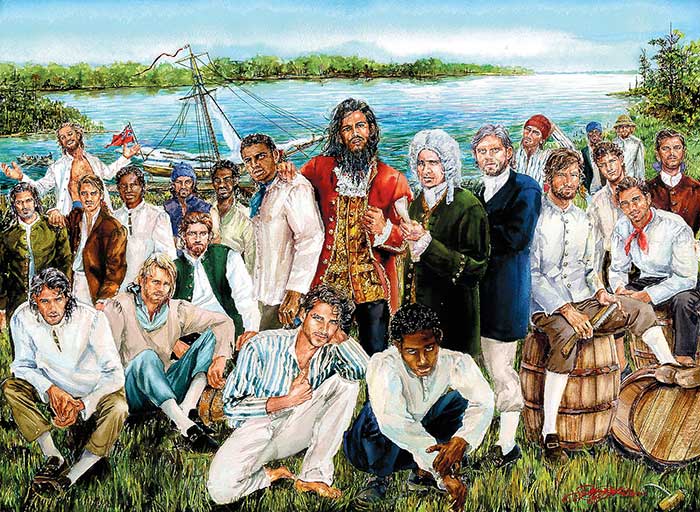
Was Blackbeard really as old as all of the illustrations depict him? Probably not! This painting is a new take on the famous pirate commissioned by Looking Glass Productions. (Watercolor by Jeffrey Jakub.)

In The Smuggler’s Gambit, one of the characters is revealed to have a past connection to one of the most famous pirates who ever lived, Blackbeard. Growing up in eastern North Carolina, I heard all kinds of Blackbeard stories growing up. He had a close connection to the families in our coastal region, so it seemed only natural that I’d incorporate some of the lesser-known history about him into my novel.

Most of what is known about Blackbeard today goes back to a single source —  A General History of the Robberies & Murders of the Most Notorious Pirates by Captain Charles Johnson (pseudonym), more popularly known as A General History of the Pyrates, published in 1724 and often attributed to Robinson Crusoe author, Daniel Defoe.

This is unfortunate, because A General History is rife with errors and misinformation. Furthermore, recent scholarship has uncovered that the true author was almost certainly Nathaniel Mist.

Thanks to diligent research, we can now dispel many of the myths that have been built up around the most famous Pirate of all time, known by the dread moniker of Blackbeard.

  1. Blackbeard may not have been born in 1680. Although books have been written that frequently rehash information that was originally published in “Capt. Johnson’s” General History, there is no solid evidence that Blackbeard was 38 when he was killed. He could have been in his late twenties or early 30s when his career was ended by Lt. Robert Maynard at Ocracoke Inlet. Oddly, even if he was 38, most images depict Blackbeard as closer to 50 or so, rather than as the young man he more than likely was.
  2. Blackbeard never murdered anyone. — At least no records exist claiming that he did. In spite of his reputation as the scourge of the seas, there is actually very little documented about him in official records anywhere. And no records exist accusing him of murder — ever. Unfortunately, that hasn’t stopped some historians and archaeologists from propagating the theory that he was a blood-thirsty killer. I guess it fits better with Hollywood’s ideas about pirates, not to mention it makes those Golden Age swashbucklers seem far more interesting when they are attributed with all varieties of heartless misdeeds.
  3. Blackbeard was not a particularly brutal or skilled fighter.  — It appears our favorite pirate relied on a carefully-cultivated reputation to cause adversaries to shake in their boots. It may come as a shock, but it’s true. In fact, other than A General History, which we now know is not entirely reliable as a historical reference book, the actual government records from the Golden Age of Piracy — both of the American colonies, as well as in England — point to only one incident during which Blackbeard actually got into a physical altercation with someone, a man named William Bell. And it was in the middle of the night on the Pamlico River. And he ended up having to call over men from his own periauger to assist him in his struggle with the man. And somehow, Blackbeard broke his sword while beating the man with it. (What was he doing? Slapping him?) Hmm… So as not to completely demolish Blackbeard’s reputation as a pirate, we do need to acknowledge that he ended up stealing a few items from the man before leaving Bell and his two passengers stranded in the middle of the river without oars or sail (which Blackbeard allegedly threw into the water). The items he took included:
    • Pistols (he took them from the man’s locked chest, although it’s unclear if he made off with them, as they aren’t specifically named in the list of stolen items)
    • £66 10s in cash;
    • A piece of crepe fabric containing 58 yards;
    • Half a barrel of brandy;
    • Some unspecified items.
  4. Blackbeard did not have lit fuses sticking out of his beard. — This silly myth surely tantalized 18th century readers who had never actually been at sea, but anyone who lives in a coastal region (like I do) knows that the winds on the water make it nearly impossible to light a match, much less keep lit fuses safely away from that bushy, flammable beard that Blackbeard was reputed to sport. Does it really make sense that a man would essentially light his face on fire, whilst walking around in the wind on board a rocking vessel? Is it likely that such a man would be able to focus much on swashbuckling maneuvers? Of course not. He’d be working too hard to constantly reposition himself so that those lit fuses didn’t set his whiskers ablaze.
  5. Blackbeard’s most valuable treasure was not gold or jewels. —  As has been discovered and documented by historian and author Kevin Duffus, the most valuable ‘loot’ ever taken by Blackbeard was the human cargo of a French slave ship called La Concorde, which he promptly renamed the Queen Anne’s Revenge. The pirate kept 60 of the slaves on board and left the rest of the 400-man company marooned with their French captain. Here is a summary according to Duffus:

Depositions filed in Charleston, S.C., later that year by former members of Blackbeard’s crew – the ones he left behind at Beaufort Inlet – are well-preserved and very detailed. When Blackbeard and his inner circle of associates sailed to Bath, they had with them 60 African men. Yet, six months later, when Blackbeard was killed at Ocracoke, he had aboard his sloop only six Africans. What happened to the 54 other African men?

“I believe they were the pirates’ secret treasure, a labor force delivered to the impoverished plantation society of the Pamlico region, which was desperately short on manpower and far from the slave markets at Williamsburg, Va., and Charleston.

“The colony of North Carolina had been wracked by years of political strife, punitive trade restrictions, drought, sickness and war with Indians. As her wealthier neighbors, Virginia and South Carolina, began to grow due to navigable, deepwater ports, the northern colony of Carolina was severely constrained by the vagaries of shoaling inlets, shallow sounds and great distances between her plantations and the traveled byways of the sea.

“Compared with South Carolina and Virginia, North Carolina had few slaves. “For the want of suitable ports negro slaves were not imported directly into North Carolina, and the planters there were forced to buy from Virginia and South Carolina. And in this very important particular North Carolina was at great disadvantage,” wrote Colonial Records editor William Saunders.”

Finally, while this isn’t specifically about Blackbeard, I’ll call this myth-buster a bonus. Many of Blackbeard’s men were said to have been hanged at Williamsburg after their captain was beheaded by Virginia’s Lt. Maynard. Of the men who were hanged, it was most probably at Hampton rather than Williamsburg. Furthermore, it turns out that the rest of his men (those who didn’t bear arms against the King’s colors) received a pardon and many went on to live out their days in and around Bath—but that part didn’t make it into history books.

The Last Days of Black Beard the Pirate author Kevin Duffus endorses The Smuggler’s Gambit

Kevin DuffusKevin Duffus, author of The Last Days of Black Beard the Pirate and 2015 NC Historian of the Year has this to say about The Smuggler’s Gambit.

“The Smuggler’s Gambit will transport you in time to a formative period in our nation’s history, when young Colonial Americans like Adam Fletcher bravely faced life-changing choices, moral perplexities, and danger at every turn. Perfectly paced with characters and dialogue so real the reader feels they are right in the middle of the action. I found this well-researched, finely-crafted tale to be altogether plausible. No doubt, this book will leave you yearning to find out what’s next for Adam Fletcher.”

Bonus: Tour the Topsail Tavern and learn about real colonial-era taverns like the Green Dragon

Whether you’ve read The Smuggler’s Gambit and want to learn more about the world of Adam Fletcher, or you’re just interesting in finding out more about the novel before reading it, this new feature will serve as your personal tour guide to the locations from the story.

About colonial era taverns

These days the word tavern often refers to establishments that primarily serve alcohol along with a limited menu. In the colonial era, however, the tavern was much more than that.

Colonial American taverns did serve the favorite drinks of the day, but they also were eating establishments and often had guest rooms that could be rented out like an inn.

While 18th century Americans certainly did not eat out as much as we do these days, the menfolk did enjoy meeting in taverns, or public houses (“pubs”), as a means of socializing and hearing the latest news. Remember, not every small town had a newspaper, and it often took a day or more for word to travel from the nearest town with a printing press to the smaller villages. The local tavern was where people would gather to visit, share news, and discuss the events of the day, and sometimes even organize responses to some of those events.

In fact, the Green Dragon Tavern of Boston might be called one of the headquarters of the American Revolution. Paul Revere was a frequent patron, and the Sons of Liberty are reported to have met in a secret basement area of the tavern. The Boston Tea Party was said to have been planned there.

Men like John Adams, Samuel Adams, and Paul Revere (as were depicted in the Sons of Liberty miniseries on History Channel) met and discussed the events that were affecting the colonies at the Green Dragon Tavern in Boston, MA.

Taverns throughout the colonies were often used as places for town meetings and in some cases, even worship services.

Women of virtue in colonial America would not have been typical tavern patrons unless they were accompanying their husband, as it would have been considered unseemly. For the most part, the only women found in taverns in those days were either those who worked as barmaids, or those who were entertaining girls (prostitutes).

The Topsail Tavern

From Chapter Three of the novel:

The Topsail Tavern was packed, as it typically was on a Friday night. In colder months, diners were left to compete with tables closest to one of the hearths at each end of the establishment, but in the month of May the warmer weather outdoors began causing the air inside the place to feel thicker. Tables near windows were preferable because of the fresh breeze that would blow through. 

Year round the air was layered with a bouquet of scents that included the more pungent briny odor of the old salts who came in to drink, the cloying perfumes of the women who occasionally came to sit with their sailors, the intoxicating fragrance of spilled rum and sweet tobacco smoke, and the yeasty aromas of strong ale and hot bread. Added to all of that was the melody of smells that emanated from whatever dishes were being brought out from the kitchen. 

Adam Fletcher was born in one of the second story rooms at the tavern and lived there with his single mother until he ran afoul of the local authorities and got forced into an apprenticeship.

Tour the Topsail Tavern

When you enter the Topsail Tavern, you’ll come in from the north side of the building.

Straight ahead, you’ll see the bar with four barstools in front. To the right of the bar is an entry way with stairs that lead up to the second floor. To the immediate left of the bar is the door that leads back to the kitchen.

The main tavern dining area is also to the left when you walk in. There are rough hewn tables and chairs around the perimeter of the room. The center of the dining area has a huge double-sided fireplace with a chimney that also has fireplaces on the second floor. It provides a welcome source of heat during the cold and drafty winter months.

Before Adam left the Topsail Tavern to go work at the shipping company, he waited tables. When he was able to sit down to rest, though, his favorite seat was always the second barstool on the left. Valentine can frequently be found sitting on a barstool behind the bar looking over his ledger books and incoming shipment orders.

Mary stays busy waiting tables nearly all the time, especially now that Adam is no longer around to help out.

In case you were wondering which table Francis Smythe and his friends were sitting at when the incident happened, it was the one in the middle against the wall on the left side of the building.

Topsail Tavern Floor Plan
This is a very basic floor plan of the main dining room in the Topsail Tavern (courtesy of floorplanner.com). Unlike in the image above, however, the tables are most certainly not uniform in size at the Topsail, but this at least gives an idea of general layout.

More bonus articles with tours of locations from The Smuggler’s Gambit are forthcoming.

  • Rasquelle Estate
  • Magistrate’s Office
  • Rogers Shipping Co.
  • Rasquelle Shipping
  • Martin Estate

Sign up to be notified when new bonus material gets posted.


Interesting in reading The Smuggler’s Gambit? Download a free excerpt or buy the book.

Creative Ways of Protecting Women’s Property and Interests in 18th Century America

Many elements of The Smuggler’s Gambit were inspired by real incidents that I uncovered while doing genealogical research—from the idea of forced apprenticeships, to the truth about Blackbeard, and many other bits and pieces of information.

In the book, there is a reference to one of the female characters being an heiress, but being bound to some key restrictions that had been placed upon her in her father’s will.

While I have never seen anything quite like the exact scenario in the book, I have found various other legal maneuvers throughout the eighteenth and nineteenth centuries that were employed to protect women’s property and interests. This is the first in a series of articles that will cover three very different kinds of circumstances:

  • A prohibition to marry
  • A refusal to marry
  • A promise of freedom

I should point out, that with the exception of one of these situations—the woman who refused to marry—that the individuals discussed in the articles in this series are not my ancestors, however, I did find their records while doing genealogy research.

Prohibition to marry — Sally Handley (Born about 1786 in Wayne County, NC)

How did I find this record?: I was searching in various eastern North Carolina records for a family that could be connected to my 4th-great-grandfather, Laban Morris. Laban was not a Morris by birth, but apparently had the last name “Henby” until he had his named legally changed to Morris in 1810. As such, I was looking for any families within that particular region of the state that might have a name that sounded anything like Henby. One name I came upon was “Handley.” Ok, so it doesn’t sound much like “Henby”—it was a long shot—but I wanted to leave no stone unturned.

What kind of record is it?: Last Will and Testament of James Handley, 1823 (Wayne Co., NC)

What does the record say?: This is the will of a man who was clearly quite wealthy. He bequeaths a great deal of real estate and divides up several slaves among his children. What struck me was something I had never before seen in a will. It is this item:

ITEM 2nd I lend unto my daughter Salley Handley one hundred acres of Land where Milley Head now lives joining Henry Roberts line as long as She continues to live without marriage also I lend my daughter Salley Handley during her Natural Life two Negroes named Cloe and Sabo and after her death it is my will that they and their increase should be equally divided between her five children to wit Washington, Penelope, Jackson, James and John Rasmus Handley. I give to my daughter Salley Handley my riding mare bridle and saddle one cow and calf one feather bed and furniture one flax wheel one woolen wheel one dish half dozzen (sic) plates one case knives & forks one table one flat iron one iron pot rack and pot and as much provisions of all kind as may be necessary for the support of herself and family one year from my death.

What does it mean? While I’ve yet to uncover any detailed biographical information about Salley Handley, I think we can assume from this part of her father’s will that she had given birth to five children outside of wedlock, otherwise, she’d have had her husband’s last name. Now, realistically, considering the time frame of this will, we can probably guess that one of two scenarios was likely: either she was mentally challenged in some way and had been taken advantage of multiple times, or she was exceedingly promiscuous. Regardless of what the circumstances might have been, her father was clearly trying to protect her interests. He wanted to make sure that she had land and slaves, as well as transportation (‘my riding mare bridle and saddle’), sustenance (‘one cow and calf’), a comfortable place to sleep (‘one feather bed and furniture’), a way to be productive (‘one flax wheel one woolen wheel’) and various household necessities.

The most striking part of the property he bequeaths to her is the land that he ‘lends’ to her “as long as She continues to live without marriage.”

Why would he say that? Again, we’re back to making certain assumptions, but I think it would be fair to say that he knew enough about his daughter that she would not likely make good decisions about what kind of man would make a virtuous husband and father. As such, he wouldn’t want some man coming in off the street to marry her just for the sake of getting his hands on her property. We must remember that in those days, if a woman married, through the legal concept of coverture, her property became marital property and her husband would have control of it. By lending her the property during her natural life unless she marries, he is making sure she has what she needs, but it will also deter potential gold-diggers who might want to marry her to acquire her property. According to Encyclopaedia Britannica, coverture began to be, “disassembled in the United States through legislation at the state level beginning in Mississippi in 1839 and continuing into the 1880s.”


The next article in this series will be about my 4th-great-grandmother, who was married once, but then apparently said, “never again.”

Capt. Horatio Sinbad gives his hearty endorsement to The Smuggler’s Gambit

A well-known figure on the pirate re-enactments circuit, as well as a ship-builder, author, and certified ‘Pirate-Privateer’, Captain Horatio Sinbad knows a thing or two about adventure on the high seas, as well as in coastal towns like Beaufort, North Carolina, the home port of his ship, MEKA II. 

Now, he lends his hearty endorsement to The Smuggler’s Gambit, the first novel in the Adam Fletcher Series:

Captain Horatio SinbadWith the real historic seaport town of Beaufort, NC as the setting, Sara Whitford has successfully woven a fast-moving adventure of intrigue, romance, deception, and betrayal.

I will be standing by for Captured in the Caribbean, the next book in the continuing saga.

Your servant, 

Captain Horatio Sinbad
Privateer, MEKA II
Beaufort, NC

« Previous Page
Next Page »