• Skip to primary navigation
  • Skip to main content
  • Skip to primary sidebar

Adam Fletcher Adventure Series

Bestselling, family-friendly historical fiction set on the colonial North Carolina coast

  • Home
  • The Author
  • Blog

History

The Spanish Invasion of Beaufort: How slaves turned settlers became pawns in Spain’s hand

Francisco Menendez (left), a runaway slave who became captain of the Fort Mose militia, may have had some involvement with the Spanish invasion of Beaufort in 1747.
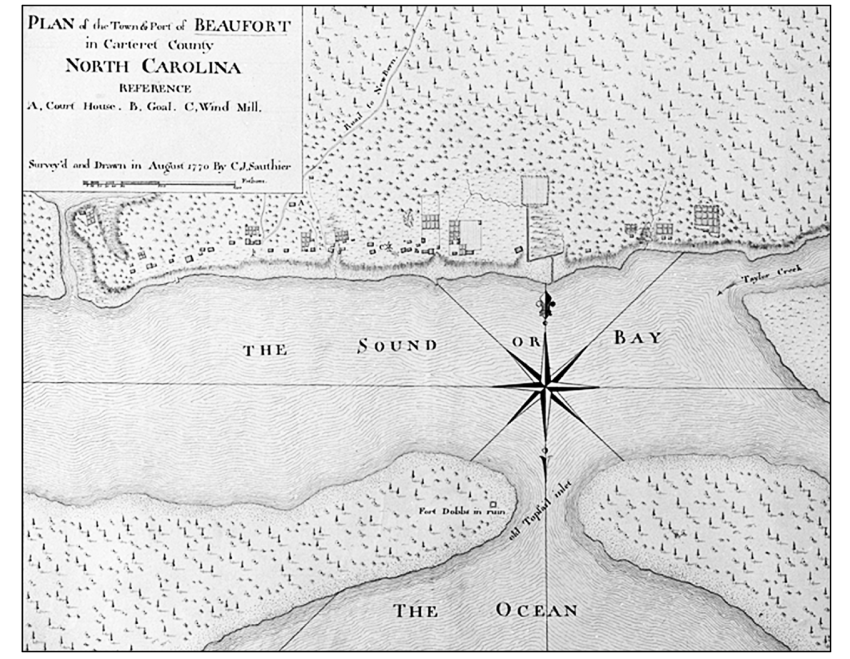
Francisco Menendez (left), a runaway slave who became captain of the Fort Mose militia, may have had some involvement with the Spanish invasion of Beaufort in 1747. (Background map was a 1770 “Plan of the Town & Port of Beaufort” by cartographer C.J. Sauthier)

Book 1

On Adam Fletcher’s first day as an apprentice (in The Smuggler’s Gambit), he is placed under the instruction of Boaz Brooks, senior cooper and second-in-charge at the shipping company. Adam learns that Boaz was also forced into an apprenticeship when he was younger. As they share their personal histories, one of the topics that arises is the 1747 Spanish invasion of Beaufort. In book 2, Captured in the Caribbean, more information comes out about that frightening event.

Although the event isn’t explored in depth in the novel, it was a very real part of Beaufort history. To date, however, no one has really explored the subject of who exactly those Spaniards were who took the town.

That is, until now.

What we already know

In the Preface to Volume 22 of the State Records of North Carolina, we are told that Spaniards invaded the coast in three different locations spanning a period of nearly a decade. The first instance occurred in 1741 near Ocracoke Inlet. The final instance occurred along the Cape Fear when Spaniards invaded Brunswick in 1748. The Beaufort invasion, however, took place in 1747 and is summarized in this way:

In June, 1747, the Spaniards took possession of the town and harbor of Beaufort, and Colonel Thomas Lovick called out his regiment to repel them. Major Enoch Ward was on duty with fifty-eight men when the town was taken on 26 August, and the alarm continued until 10 September, although probably the Spaniards departed earlier. On 6 September William Moore brought in his bill against the public for fifteen hundred pounds of beef for maintaining and imprisoning ten Spanish negroes, and for a gun which had burst in time of action which he said cost him eighty pounds. These Spanish vessels were largely manned by negroes and mulattoes.

At the bottom of this article, there is a list of the brave Beaufort citizens who banded together to fight off these Spanish marauders and restore peace and tranquility to the otherwise quiet seaport town.

Who were these Spanish “negroes and mulattoes” and what did they want?

In The Colonial Records of North Carolina, Volume 4, we are given a bit more information about these men:

In 1747, several small sloops and barcalonjos crept along the coast from St. Augustine, full of armed men, mostly mulattoes and negroes, their small draught securing them from the attacks of the only ship of war then on our coast. They landed at Ocacock, Core Sound, Bear Inlet and Cape Fear, where they killed several people, burned some ships and small vessels, carried off some negroes and slaughtered a great number of cattle and hogs. These practices continued all the summer of 1747, and led to the erection of several forts along the coast, one of which, Fort Johnston, still survives.

Why would “negroes and mulattoes” have “carried off some negroes”?

I can think of a few reasons, but perhaps if we learn who these black Spaniards from St. Augustine were we can better ascertain why they would’ve been interested in taking local “negroes” with them.

Fort Mose ” The Spaniard’s Gambit?

Established in 1738 as the first free black settlement in what would eventually become the United States, Gracia Real de Santa Teresa de Mose, or “Fort Mose” (pronounced Moh-say) for short, was located just outside St. Augustine, Florida. It was created as a Spanish sanctuary of sorts for runaway slaves from the Carolinas. They were welcome to stay in the settlement as free men and women provided they would convert to Catholicism and pledge their allegiance to the King of Spain.

It should be pointed out that their allegiance meant that their position just north of St. Augustine demanded the residents of Fort Mose act as the northern defense for America’s oldest city, a challenging position considering Spain’s enemies to the north were the English.

Just two years later, in 1740, their allegiance was put to the test when British forces came from Georgia, led by James Oglethorpe, with the intention of taking over the fort. Spanish troops, along with local Indians and the free black militia counterattacked and ran the British troops out, but destroyed the original fort in the process. For a time, the residents of Fort Mose relocated to St. Augustine and lived among the Spanish there, but it wasn’t to last.
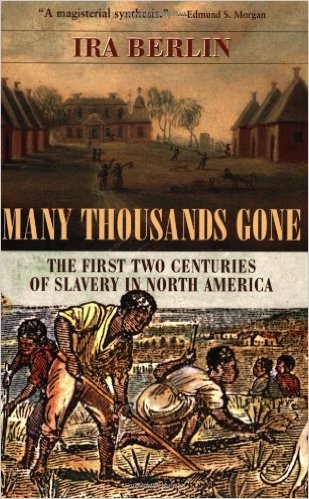
Many Thousands Gone: The First Two Centuries of Slavery in North AmericaIn his book, Many Thousands Gone: The First Two Centuries of Slavery in North America, historian Ira Berlin writes:

Declaring themselves “vassals of the King and deserving of royal protection,” they continually put themselves in the forefront of service to the Crown with the expectations that the Crown would reciprocate.

Hoped-for rewards were not always forthcoming. All “vassals of the King” were not equally favored. Beginning in 1749, a new governor of Florida forced black people to return to Mose, much against their will, as they had enjoyed the cosmopolitan life of St. Augustine, where their ability to converse in several European, Indian, and African languages gave them a place as cultural brokers in a multicultural society. 

Make no mistake about it, mercy and compassion are not what prompted the Spanish government to welcome fugitive slaves into the Florida colony. It was a strategic decision. What better way to destabilize the fledgling English colonies to the north than to entice their labor force”albeit their slave labor force”to run south? And then, on top of that, they expected those slaves-turned-settlers to take up arms against any threats to Spain and her territories.

Maybe even return to the colonies from whence they came to take their countrymen and exact a bit of revenge?

Why was Beaufort a target?

As it said earlier in this article, the attack on Beaufort was one of a series of attacks on the coast of North Carolina by Spaniards. Again, it was strategic. According to historian Charles L. Paul, the population of taxables in Carteret County in 1748, the year after the invasion, was only 320, while the taxables for the town of Beaufort was only one-tenth of that number, or just 32. (In North Carolina, taxables, or tithables, were defined as follows, “¦every white Person Male of the age of Sixteen Years and upwards all Negroes Mulattoes Mustees Male or female and all Persons of Mixt Blood to the fourth Generation Male and Female of the age of twelve years and upwards, and no other Persons whatsoever, shall be deem™d Tithables.”)

Beaufort, North Carolina - Sauthier map, 1770
This map was made twenty three years after the Spanish attack on Beaufort.

In other words, Beaufort would’ve been seen as a point of weakness in the colony. Spanish attacks weren’t launched on the more populous areas.

Since the report said, “they killed several people, burned some ships and small vessels, carried off some negroes and slaughtered a great number of cattle and hogs,” it’s entirely possible that the purpose of the attack was to either free or take slaves and generally create mayhem, weakening the town by destroying property.

North Carolina didn’t have any great ports like Charleston. The ports that did exist in the colony were critical to its success. By launching attacks at various points along the coast, the Spanish invaders were proving their allegiance to the King of Spain by attacking his enemies in the English colony and perhaps enjoying a bit of indirect revenge on the Carolinas where they, or their forebears, had originally been enslaved.

What became of the free blacks of Fort Mose and St. Augustine?

Most of the black population of Fort Mose and St. Augustine ended up accompanying their Spanish compatriots to Cuba after Florida was ceded to the British with the Peace of Paris in 1763. (Britain temporarily had control of Havana”for nearly one year from 1762 to 1763”until they agreed to give it back to Spain in exchange for East Florida. West Florida was already under British control.)

According to Berlin, while the the black population at St. Augustine and Fort Mose totaled about 3,000, only about a quarter of them were free. While the National Park Service has called Fort Mose a precursor site to the Underground Railroad, a full three-quarters”totaling over 2,000 souls”of the black inhabitants of this “free black settlement” were enslaved.

It’s even possible that the “negroes” taken during the raid on Beaufort were, themselves, brought into slavery in Florida.

Who were the men who fought off the Spanish marauders?

Thanks to the wonderful documentary work of Joel S. Russell, we have a great deal of Carteret County historical and genealogical information available online at his website. He has lists for four key dates involving Beaufort’s history with the Spanish invasion. The first, June 14, 1747, was when Spanish ships were out in the bay taking ships. The second, August 26, 1747, was the day the Spaniards took Beaufort. The third date, September 1, 1747, was when our expanded militia began to fight off the marauders. By the fourth date, September 10, the attack on Beaufort was over.

Private Andrew Adams
Private John Arthur
Private Thomas Austin Jr
Private Thomas Austin Sr (This is my 7th-great-grandfather!)
Sergeant George Bell
Private James Bell Jr
Private John Bell
Private Newell Bell
Private Ross Bell
Private William Bowen
Private John Brown
Private William Burn
Private Cornel Canaday
Private Richard Canaday
Sergeant Thomas Canaday
Private Daniel Catholick
Private Ephraim Chadwick
Captain Charles Cogdell
Private George Cogdell
Private John Cogdell
Ensign Richard Cogdell
Private William Cole
Private Joseph Davis
Private William Dennis
Private Daniel Everitt
Private Joseph Fulford
Private Joseph Fulford Jr
Lieutenant Edward  Fuller
Private Richard Gabriel
Private Dederick Gibble
Private Thomas Gillikin
Private Thomas Gillikin Jr
Private Benjamin Guthrie
Private Benjamin Hancock
Private Nathaniel Hancock
Private David Hicks
Private Samuel Howland
Private Ambrose Jones
Private David Lewis
Private Thomas  Love
Private John McDowell
Private Jobe Meders
Private Timothy Merryhew
Sergeant Joseph Morris
Private Joshua Nash
Private Samuel Negus
Private George Neithercott
Private Elias Nelson
Private John Nelson
Private William Owen
Private Nicholas Pacquinett
Private Isaac Parker
Private Peter Piver
Private Robert  Polk
Private Robert  Potts
Private Laughlin  Quin
Rgt. Clerk George Read
Private Daniel Rees
Private John  Roberts
Private William Roberts
Private Daniel Ross
Ensign John  Shackleford
Private John Shackleford
Private David Shepard
Private Edward Shepard
Private Cornelius Simpson
Private Edward Simpson
Private John Simpson
Private Joshua  Simpson
Private Benjamin Small (and son)
Private William  Taylor
Private Richard  Thompson
Private Resolve  Waldron
Major Enoch Ward
Private Richard Ward
Private Valentine Ward
Private Jonas Weeks
Private Lewis Welsh
Private Maddock  Wharton
Private Samuel Whitehurst
Private John Williamson
Private Richard  Williamson
Sergeant John Williston
Private John Williston
Private Thomas Williston
Private James Woodland
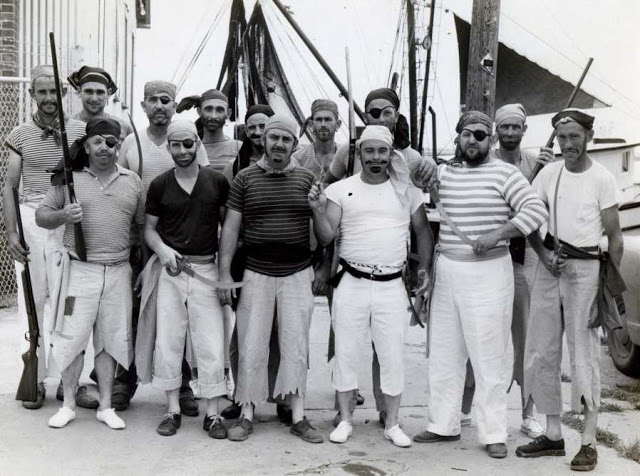
 

The original participants of the Beaufort Pirate Invasion in 1960
From Mary Warshaw’s article – “On July 9, 1960, town firemen participated in Beaufort’s first reenactment of the Spanish invasion ” implemented from an idea by Grayden Paul.”

The Annual Beaufort Pirate Invasion

Beautiful historic Beaufort, NC is a town that loves its history ” both real and imagined ” and in 1960, the first ever re-enactment of the Spanish invasion took place as a way of commemorating the victory of the Beaufort militia over the attacking Spaniards.

Beaufort artist, author, and historian extraordinaire, Mary Faith Warshaw, has a very thorough article on the history behind the original Spanish invasion as well as a summary of the re-enactments in 1960 and 1961.

These days, an event known as the Beaufort Pirate Invasion has taken things into a slightly different direction, bringing in Pirate re-enactors from all over the country to spend two days acting out scenes that are more reminiscent of the Golden Age of Piracy (or Pirates of the Caribbean) rather than the 1747 Spanish attack.

While the contemporary festivities aren’t strictly a re-enactment of what happened in that frightening summer of 1747, it’s still a wonderful event of great fun that will hopefully get folks interested in learning about the real history of the town and the region.

(This article was originally published April 14, 2015.)

The Real Blackbeard: Get ready to have everything you thought you knew turned on its head

Kevin Duffus is the author of The Last Days of Black Beard the Pirate and is NC Historian of the Year for 2015

In The Smuggler’s Gambit, one of the characters turns out to have a history with the pirate Blackbeard. As he recounts the experiences of his youth, he tells a different story than what legends and myths have had many of us believe over the years.

I credit my good friend, Kevin Duffus, author of The Last Days of Black Beard the Pirate and North Carolina Historian of the Year (2015), with his ground-breaking research on the most famous pirate who ever lived. If you have an hour, you’ll learn in this video that everything you thought you knew about Blackbeard is wrong.

Here are just a few highlights from the lecture:

  • Blackbeard was not middle-aged when he was killed in his final battle with Lt. Maynard. In fact, he was probably only about 28 years old.
  • None of the artistic impressions (woodcuts, portraits, etc.) of Blackbeard are based on any eyewitness accounts.
  • Blackbeard’s real name wasn’t Edward Teach or Edward Thache, or anything of the sort.
  • Blackbeard’s greatest treasure wasn’t gold. Do you know what it was? This video will tell you.

What’s Wrong with Black Beard? by Kevin P. Duffus (Video) from Virginia Historical Society on Vimeo.


(Originally published May 15, 2015.)

What is the truth about the Lost Colony? “ New insight into America’s oldest “mystery”

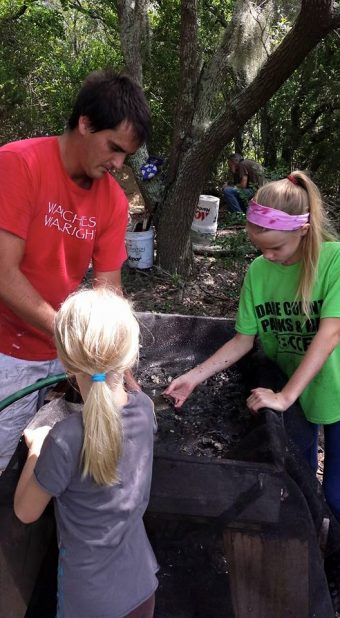
Scott Dawson in the field showing his daughters how to do archaeology.

This isn’t an article about Adam Fletcher. And it isn’t even an article about Colonial Beaufort, or even Colonial America.

This is about something that goes back even earlier…

Recently, more than one television documentary has offered viewing audiences one spin after another about one of America™s favorite historical mysteries“the Lost Colony. Through my work with Coastal Carolina Indian Center, as well as my own roots in the region that go back to the earliest colonists and the Algonquian peoples of the coast, I have always had a particular interest in the Lost Colony, but also the other Roanoke expeditions as well. (Yes, there were others.) It was in those expeditions that Thomas Harriot recorded his experiences with the first indigenous Americans who ever encountered the English. It was during those same expeditions that John White created the beautiful watercolor illustrations that give us a glimpse of what life was like in America in the 1580s.

When one has a personal connection to a certain history, it tends to inspire a great passion about it. That seems to certainly be the case with Scott Dawson, who along with his wife, Maggie, founded the Croatoan Archaeological Society. I’ve known Scott for years. He has contributed articles and materials to our CCIC website. Earlier this week I interviewed him about recent discoveries related to the Lost Colony and the related Roanoke expeditions, as well as what his organization is doing to help uncover a fuller picture of the history.

Q “ A lot of news articles and documentaries have been coming out over the last year relating to the Lost Colony. In fact, I understand there was one on the History Channel recently that talked about the Dare Stones. What do you know about that?

A “ I was on the History Channel a few years ago and they were doing a show about the Dare Stones, but they never told me that was what the show was about. When they contacted me they said it was about the “lost colony” and they were interested in the archaeology we had been doing in Hatteras. I had no idea it was a quack show or I would have never agreed to go on it.

The Dare Stones are a hoax, as any reasonable person can tell. The first stone was found the year the Lost Colony play came out in 1937. When that play began, it created the mystery of the “lost colony” to sell tickets and the public was hoodwinked into thinking it was a real mystery.

Magically, the first stone pops up and is authored by none other than a member of the Dare family, of course.

The entire area where the stone was found was excavated, but nothing was found. Later, 41 more stones were found“none of them even in the state of North Carolina“and all by just four people, which it turns out all knew each other and even tried to blackmail a professor into saying they were real.

It was put to bed as a hoax a long time ago in the 1940s, but I guess it makes good TV“so there you have it.

The idea the colony walked to the outskirts of Atlanta and left a trail of stones behind and no other artifacts is probably the dumbest of a host of stupid theories out there.

Q “ The outdoor drama about the Lost Colony has been really popular over the years and is a big tourist draw. Would you say that it’s an accurate portrayal of the history?

The Lost Colony play has been a tourist draw and that is why it was created.  I don™t think the play even pretends to be accurate. Almost nothing about the play is accurate.

The very idea they are lost isn™t even accurate.

Real history from the primary sources is not ambiguous at all about the fate of the colony. The œlost colony of 1587 was the fourth English voyage to North Carolina.

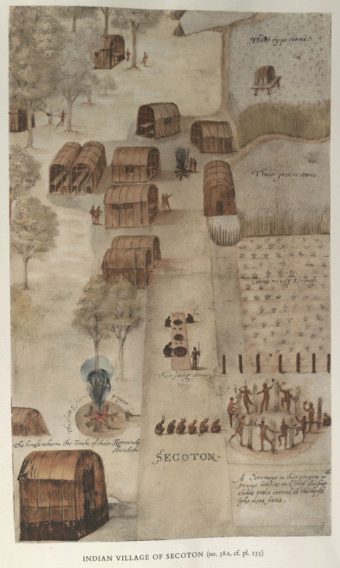
This watercolor of Secotan“an Indian village that was across Pamlico Sound from Hatteras island“was created by John White during one of the Roanoke expeditions.

The first voyage landed at Hatteras Island“then called Croatoan. This is the voyage that met Manteo“who was from Croatoan“not Roanoke. They only spent one night on Roanoke Island during the six-week stay of the first voyage. A relationship had begun with the Croatoan of Hatteras Island that continued for years.

The second voyage had English people living on BOTH Hatteras Island and Roanoke Island. The English were at war with Indians from the adjacent mainland and killed their Chief and burned one of their villages before going back to England.

The third voyage was just 15 men left on Roanoke who got attacked by the mainland Indians.

The fourth voyage was the one known as the Lost Colony and they were only stopping by to get the 15 men from the year before, only to discover they had been killed.

The Lost Colony also had a man, George Howe, [who was] killed in 1587 by mainland Indians. When this happened, they sent 20 men with Manteo to his home, Hatteras, to get help. They were hosted to a feast and told that the Croatoan of Hatteras would try to smooth things over for the English with the mainland. Instead, they sacked a mainland village and stole all the corn and split it with the English. When the governor left and instructed the colony to carve out where they had moved to, it was no shocker that they wrote “Croatoan.” This is a tribe the English had known for years and the only tribe in the area who did not want to kill them. These are facts.

Unfortunately, if you tell the facts from the primary sources you can™t pretend the colony is lost and thus you won™t sell as many tickets.

Q “ What is your connection to this history? Why is it something that you care so much about?

A “ I am a history teacher in Elizabeth City and as I tell my students what matters the most is the truth. I feel like the mythology of the Lost Colony is a slap in the face to the Croatoan people.

In the real history, they fed and cared for the English and undoubtedly adopted them in the end. Yet in the mythology, they are marginalized to a strange message on a palisade and all mention of their contact with the English is swept under the rug.

Q “ You have been researching this history for years and you’ve found many archaeological artifacts, right? Many of them you have found just living on Hatteras?

A “ I grew up on Hatteras and my Mother™s family has lived there for at least eight generations.

We go back to the Croatoan who were still living there well into the 1750s.

There was a land grant to the Hatteras Tribe in 1751 that was signed by the colonial governor Arthur Dobbs.

My family still lives on that land, as well as many other families, most of whom have been doing so since they were wearing deerskins.

I have found thousands of pieces of pottery and other artifacts and started doing so when I was 10 years old. Now I head a non-profit group and got professionals from the University of Bristol to start doing archaeology there for the last seven years.

Anyone who knows me knows I told them exactly where the Croatoan villages were and predicted 16th century material would be in the village. So far we have located more than one Croatoan village and found several 16th century English artifacts mixed in with Croatoan exactly where I and pretty much everyone on the island has always said it would be.

Q “ I’m aware that a university in England has taken interest in digging at Buxton. How did the Croatoan Archaeological Society (CAS) come to partner with an archaeology team from across the pond? And why do you think North Carolina universities haven’t gotten involved?

A “ North Carolina Universities would probably love to be involved, but unfortunately, the property owners“at least most of them“do not trust them. ECU did some digs in the late 1990s and they also took artifacts that people had brought for them [back to the university] to look at and never returned them.

It is a very small community and they burned that bridge.

The University of Bristol (UoB) from England was a good choice, after all, this is their history too. We have always had American volunteers and many Americans from the University of Michigan, William and Mary and South Carolina have been involved in one way or another. In fact, our last dig was mostly Americans.

Usually the British outnumber us on these digs, but it is a great opportunity for the school kids of Hatteras to get some exposure to a different culture. The UoB students have done digs at the high school with local students and we actually found some pottery from about the year 500 behind the school.

CAS is a community organization so we work with the school and do all kinds of programs for the kids.

UoB has been wonderful. I can™t say anything but positive comments on their work ethic, professionalism and dedication. Dr. Mark Horton is the leader and when I met him in 2009, he had me pick the places to dig, secure permission, and off we went. The finds were so amazing he told me we needed to get organized and form CAS, so we did.

Q “ What have been some of the most interesting finds in your excavations?

A “ Everyone would answer this question differently. Obviously the English stuff from the 1500s such as a writing slate, a rapier (sword handle) and the Nuremberg token, copper bun, Elizabeth glass and all the œlost colony stuff is at the top of the list for most.

For me it is seeing the postholes of the Croatoan longhouses and knowing exactly where their houses were. I also like the really old stuff we have found“some of the spear points are thousands of years old.

I like anything with art on it too, especially the Native pottery and some of the decorated pipes. The whole thing is amazing. It is as close to time travel as it gets.

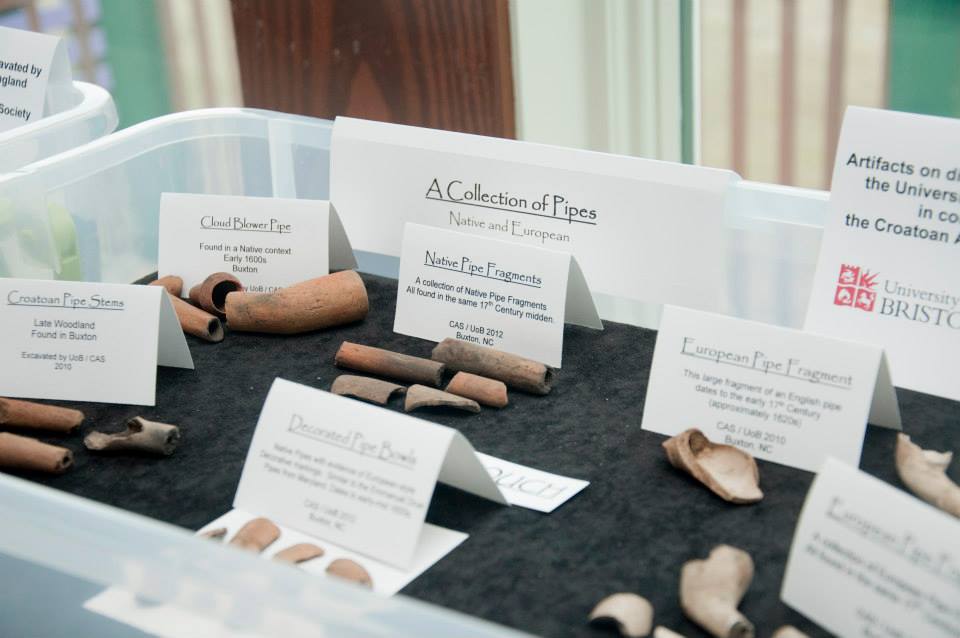
A glimpse of some of the artifacts found in excavations by Croatoan Archaeological Society and the University of Bristol

Q “ What do those finds mean for interpreting the history of the so-called Lost Colony?

A “ It means the “lost colony” wasn™t lost. They were abandoned and went exactly where they indicated they went with the CROATOAN message.

If anything is a mystery, it is that no one looked in the most obvious location for almost 400 years.

It goes to show how few people actually read primary sources and how much misinformation is circled around by so many so called experts.

It is sad really, because now that we have the evidence we have to deal with these competing theories that have no basis in reality like the Dare Stones, or Beechland, or Bertie.

If people would just read the historical context of the colony they would know that going inland would be like a Jewish family during World War II fleeing Poland by going to Germany! The mainland was attacking and killing the English, whereas Croatoan had been feeding and protecting them for years. Not to mention the fact the colony carved “CROATOAN” in the palisade to indicate that is where they went, and now we found their stuff there.

It™s irritating, but I think any reasonable person can understand the colony went to Croatoan if given the facts.

The London Times featured the work of the archaeological discoveries documented by Professor Mark Horton (University of Bristol - England) along with Croatoan Archaeological Society.
The London Times featured the work of the archaeological discoveries documented by Professor Mark Horton (University of Bristol – England) along with Croatoan Archaeological Society.

Q “ In your opinion, what happened to the Lost Colonists? Where did they end up? Did they survive? Did they“as some have suggested“go into the sassafras business?

First of all, sassafras grows all over the state“including Hatteras, and even Roanoke“so the idea they would go inland to get it is like saying they went inland to get pinecones or acorns.

Clearly, they went to Croatoan as they indicated.

I do not think they faired very well regardless of where they went because Jamestown is only 20 years later and no one ever sent word to Jamestown saying anything.

If you look at Jamestown almost all of them died in the first few year“and they had help from Indians too. It is only by sheer weight and constant resupply that they managed to survive.

This is not to say that some colonists did not pass on a few offspring with the Croatoan. In fact, in 1701 John Lawson reported grey eyed Indians on Hatteras who told him flat out that they had white ancestors who came on Sir Walter Raleigh™s ships.

Most likely what was left of the 1587 colony died off in the winter of 1602. This was a record cold winter due to a volcano that erupted in South America and caused record lows across North America.

Who knows? Saying the colony went to Croatoan is one thing, but after that it is a speculation game. In my opinion they didn™t do too well, passed on a few children with the Croatoan, and perished. If they had lived and thrived they would have contacted Jamestown and no one did so.

Q “ Everyone always talks about the colonists, but what about the Indians? What happened to the indigenous people from Hatteras? Did they survive?

The Natives of Hatteras like so many other tribes on the coast did survive but they were greatly reduced by disease and war. They fought on the side of the English in the Tuscarora War in 1711 and we have a handful of references to them in the 1700s when they had been reduced to less than 100 people. The archaeology shows they were still thriving in the 1600s with a healthy diet of deer, fish, birds, turtles, shellfish and that they had some access to European trade goods like brandy and guns. In the end they intermarried with white people and stayed on the island. That is where my family comes from, as well as most other old families on the island. Many visitors to the island in the 1700s reported a mixed race community living there and by the late 1700s the archaeology goes completely European.

Q “ What have you found to be some of the biggest misconceptions regarding the history about the Lost Colony and the indigenous people of Croatoan and the surrounding areas?

One misconception is that the Croatoan did not have much to eat and could not support the colony. To quote Dr. Horton, that idea is œcomplete rubbish.

Another misconception is that the Croatoan did not live on Hatteras year round. We can prove they did, and in fact have for thousands of years.

Another misconception is that Croatoan was some strange word left by the colony. It is a real place and real people that the colony had had contact with since 1584, and a known ally of the colony. I think that might be the biggest misconception. There are so many misconceptions, most of which were created to aid the mythology.

Q “ Where can people learn more about your organization and its discoveries?

The Croatoan Archaeological Society website is www.cashatteras.com or they can find us on facebook.

Also, my book Croatoan: Birthplace of America, details a lot of the history. We also have displays of the artifacts at the county library in Hatteras Village that can be seen for free. We are updating that location soon with new cases and more artifacts.

The whole point of CAS is to preserve the real history of the island and share it with the world. We have a few discoveries that have not been announced yet and no doubt more to unearth. Stay tuned, or better yet sign up and join us to be a part of history!

Five things you DIDN’T know about Blackbeard

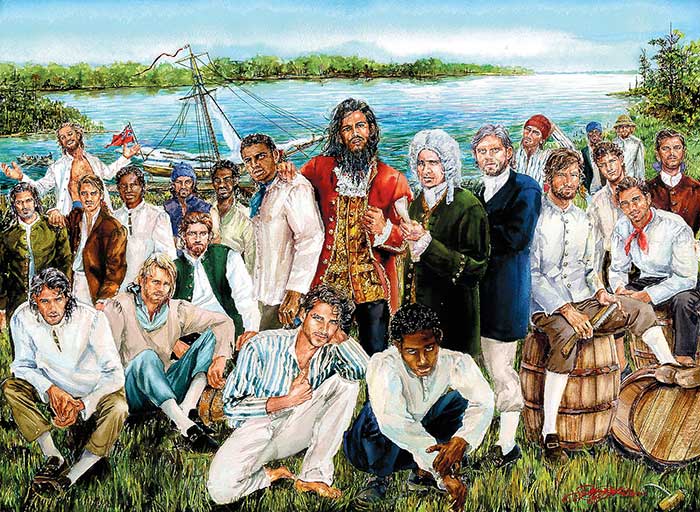
Was Blackbeard really as old as all of the illustrations depict him? Probably not! This painting is a new take on the famous pirate commissioned by Looking Glass Productions. (Watercolor by Jeffrey Jakub.)

In The Smuggler’s Gambit, one of the characters is revealed to have a past connection to one of the most famous pirates who ever lived, Blackbeard. Growing up in eastern North Carolina, I heard all kinds of Blackbeard stories growing up. He had a close connection to the families in our coastal region, so it seemed only natural that I’d incorporate some of the lesser-known history about him into my novel.

Most of what is known about Blackbeard today goes back to a single source ”  A General History of the Robberies & Murders of the Most Notorious Pirates by Captain Charles Johnson (pseudonym), more popularly known as A General History of the Pyrates, published in 1724 and often attributed to Robinson Crusoe author, Daniel Defoe.

This is unfortunate, because A General History is rife with errors and misinformation. Furthermore, recent scholarship has uncovered that the true author was almost certainly Nathaniel Mist.

Thanks to diligent research, we can now dispel many of the myths that have been built up around the most famous Pirate of all time, known by the dread moniker of Blackbeard.

  1. Blackbeard may not have been born in 1680. Although books have been written that frequently rehash information that was originally published in “Capt. Johnson’s” General History, there is no solid evidence that Blackbeard was 38 when he was killed. He could have been in his late twenties or early 30s when his career was ended by Lt. Robert Maynard at Ocracoke Inlet. Oddly, even if he was 38, most images depict Blackbeard as closer to 50 or so, rather than as the young man he more than likely was.
  2. Blackbeard never murdered anyone. ” At least no records exist claiming that he did. In spite of his reputation as the scourge of the seas, there is actually very little documented about him in official records anywhere. And no records exist accusing him of murder ” ever. Unfortunately, that hasn’t stopped some historians and archaeologists from propagating the theory that he was a blood-thirsty killer. I guess it fits better with Hollywood’s ideas about pirates, not to mention it makes those Golden Age swashbucklers seem far more interesting when they are attributed with all varieties of heartless misdeeds.
  3. Blackbeard was not a particularly brutal or skilled fighter.  ” It appears our favorite pirate relied on a carefully-cultivated reputation to cause adversaries to shake in their boots. It may come as a shock, but it’s true. In fact, other than A General History, which we now know is not entirely reliable as a historical reference book, the actual government records from the Golden Age of Piracy ” both of the American colonies, as well as in England ” point to only one incident during which Blackbeard actually got into a physical altercation with someone, a man named William Bell. And it was in the middle of the night on the Pamlico River. And he ended up having to call over men from his own periauger to assist him in his struggle with the man. And somehow, Blackbeard broke his sword while beating the man with it. (What was he doing? Slapping him?) Hmm… So as not to completely demolish Blackbeard’s reputation as a pirate, we do need to acknowledge that he ended up stealing a few items from the man before leaving Bell and his two passengers stranded in the middle of the river without oars or sail (which Blackbeard allegedly threw into the water). The items he took included:
    • Pistols (he took them from the man’s locked chest, although it’s unclear if he made off with them, as they aren’t specifically named in the list of stolen items)
    • £66 10s in cash;
    • A piece of crepe fabric containing 58 yards;
    • Half a barrel of brandy;
    • Some unspecified items.
  4. Blackbeard did not have lit fuses sticking out of his beard. ” This silly myth surely tantalized 18th century readers who had never actually been at sea, but anyone who lives in a coastal region (like I do) knows that the winds on the water make it nearly impossible to light a match, much less keep lit fuses safely away from that bushy, flammable beard that Blackbeard was reputed to sport. Does it really make sense that a man would essentially light his face on fire, whilst walking around in the wind on board a rocking vessel? Is it likely that such a man would be able to focus much on swashbuckling maneuvers? Of course not. He’d be working too hard to constantly reposition himself so that those lit fuses didn’t set his whiskers ablaze.
  5. Blackbeard’s most valuable treasure was not gold or jewels. ”  As has been discovered and documented by historian and author Kevin Duffus, the most valuable ‘loot’ ever taken by Blackbeard was the human cargo of a French slave ship called La Concorde, which he promptly renamed the Queen Anne’s Revenge. The pirate kept 60 of the slaves on board and left the rest of the 400-man company marooned with their French captain. Here is a summary according to Duffus:

Depositions filed in Charleston, S.C., later that year by former members of Blackbeard’s crew – the ones he left behind at Beaufort Inlet – are well-preserved and very detailed. When Blackbeard and his inner circle of associates sailed to Bath, they had with them 60 African men. Yet, six months later, when Blackbeard was killed at Ocracoke, he had aboard his sloop only six Africans. What happened to the 54 other African men?

“I believe they were the pirates’ secret treasure, a labor force delivered to the impoverished plantation society of the Pamlico region, which was desperately short on manpower and far from the slave markets at Williamsburg, Va., and Charleston.

“The colony of North Carolina had been wracked by years of political strife, punitive trade restrictions, drought, sickness and war with Indians. As her wealthier neighbors, Virginia and South Carolina, began to grow due to navigable, deepwater ports, the northern colony of Carolina was severely constrained by the vagaries of shoaling inlets, shallow sounds and great distances between her plantations and the traveled byways of the sea.

“Compared with South Carolina and Virginia, North Carolina had few slaves. “For the want of suitable ports negro slaves were not imported directly into North Carolina, and the planters there were forced to buy from Virginia and South Carolina. And in this very important particular North Carolina was at great disadvantage,” wrote Colonial Records editor William Saunders.”

Finally, while this isn’t specifically about Blackbeard, I’ll call this myth-buster a bonus. Many of Blackbeard’s men were said to have been hanged at Williamsburg after their captain was beheaded by Virginia’s Lt. Maynard. Of the men who were hanged, it was most probably at Hampton rather than Williamsburg. Furthermore, it turns out that the rest of his men (those who didn’t bear arms against the King’s colors) received a pardon and many went on to live out their days in and around Bath”but that part didn’t make it into history books.

Primary Sidebar

Please note: All links to vendor sites are provided as part of an affiliate program.

About the Author

Sara Whitford's third-great-grandfather, William Morris, wrote their family lineage in a worn old copy of Robinson Crusoe. Adventure, literature, and history are in her blood. Ever since she can remember, she has been fascinated by the intriguing past of the coastal North Carolina region that has been home to her … Read more about About the Author