• Skip to primary navigation
  • Skip to main content
  • Skip to primary sidebar

Adam Fletcher Adventure Series

Bestselling, family-friendly historical fiction set on the colonial North Carolina coast

  • Home
  • The Author
  • Blog

Colonial History

Five things you DIDN’T know about Blackbeard

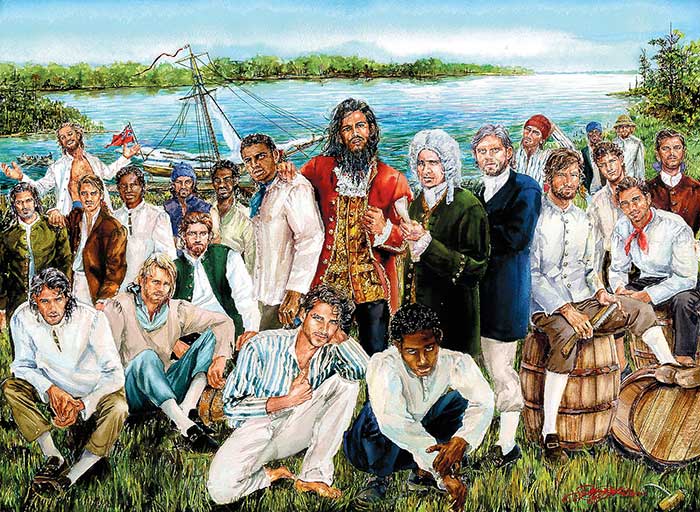
Was Blackbeard really as old as all of the illustrations depict him? Probably not! This painting is a new take on the famous pirate commissioned by Looking Glass Productions. (Watercolor by Jeffrey Jakub.)

In The Smuggler’s Gambit, one of the characters is revealed to have a past connection to one of the most famous pirates who ever lived, Blackbeard. Growing up in eastern North Carolina, I heard all kinds of Blackbeard stories growing up. He had a close connection to the families in our coastal region, so it seemed only natural that I’d incorporate some of the lesser-known history about him into my novel.

Most of what is known about Blackbeard today goes back to a single source ”  A General History of the Robberies & Murders of the Most Notorious Pirates by Captain Charles Johnson (pseudonym), more popularly known as A General History of the Pyrates, published in 1724 and often attributed to Robinson Crusoe author, Daniel Defoe.

This is unfortunate, because A General History is rife with errors and misinformation. Furthermore, recent scholarship has uncovered that the true author was almost certainly Nathaniel Mist.

Thanks to diligent research, we can now dispel many of the myths that have been built up around the most famous Pirate of all time, known by the dread moniker of Blackbeard.

  1. Blackbeard may not have been born in 1680. Although books have been written that frequently rehash information that was originally published in “Capt. Johnson’s” General History, there is no solid evidence that Blackbeard was 38 when he was killed. He could have been in his late twenties or early 30s when his career was ended by Lt. Robert Maynard at Ocracoke Inlet. Oddly, even if he was 38, most images depict Blackbeard as closer to 50 or so, rather than as the young man he more than likely was.
  2. Blackbeard never murdered anyone. ” At least no records exist claiming that he did. In spite of his reputation as the scourge of the seas, there is actually very little documented about him in official records anywhere. And no records exist accusing him of murder ” ever. Unfortunately, that hasn’t stopped some historians and archaeologists from propagating the theory that he was a blood-thirsty killer. I guess it fits better with Hollywood’s ideas about pirates, not to mention it makes those Golden Age swashbucklers seem far more interesting when they are attributed with all varieties of heartless misdeeds.
  3. Blackbeard was not a particularly brutal or skilled fighter.  ” It appears our favorite pirate relied on a carefully-cultivated reputation to cause adversaries to shake in their boots. It may come as a shock, but it’s true. In fact, other than A General History, which we now know is not entirely reliable as a historical reference book, the actual government records from the Golden Age of Piracy ” both of the American colonies, as well as in England ” point to only one incident during which Blackbeard actually got into a physical altercation with someone, a man named William Bell. And it was in the middle of the night on the Pamlico River. And he ended up having to call over men from his own periauger to assist him in his struggle with the man. And somehow, Blackbeard broke his sword while beating the man with it. (What was he doing? Slapping him?) Hmm… So as not to completely demolish Blackbeard’s reputation as a pirate, we do need to acknowledge that he ended up stealing a few items from the man before leaving Bell and his two passengers stranded in the middle of the river without oars or sail (which Blackbeard allegedly threw into the water). The items he took included:
    • Pistols (he took them from the man’s locked chest, although it’s unclear if he made off with them, as they aren’t specifically named in the list of stolen items)
    • £66 10s in cash;
    • A piece of crepe fabric containing 58 yards;
    • Half a barrel of brandy;
    • Some unspecified items.
  4. Blackbeard did not have lit fuses sticking out of his beard. ” This silly myth surely tantalized 18th century readers who had never actually been at sea, but anyone who lives in a coastal region (like I do) knows that the winds on the water make it nearly impossible to light a match, much less keep lit fuses safely away from that bushy, flammable beard that Blackbeard was reputed to sport. Does it really make sense that a man would essentially light his face on fire, whilst walking around in the wind on board a rocking vessel? Is it likely that such a man would be able to focus much on swashbuckling maneuvers? Of course not. He’d be working too hard to constantly reposition himself so that those lit fuses didn’t set his whiskers ablaze.
  5. Blackbeard’s most valuable treasure was not gold or jewels. ”  As has been discovered and documented by historian and author Kevin Duffus, the most valuable ‘loot’ ever taken by Blackbeard was the human cargo of a French slave ship called La Concorde, which he promptly renamed the Queen Anne’s Revenge. The pirate kept 60 of the slaves on board and left the rest of the 400-man company marooned with their French captain. Here is a summary according to Duffus:

Depositions filed in Charleston, S.C., later that year by former members of Blackbeard’s crew – the ones he left behind at Beaufort Inlet – are well-preserved and very detailed. When Blackbeard and his inner circle of associates sailed to Bath, they had with them 60 African men. Yet, six months later, when Blackbeard was killed at Ocracoke, he had aboard his sloop only six Africans. What happened to the 54 other African men?

“I believe they were the pirates’ secret treasure, a labor force delivered to the impoverished plantation society of the Pamlico region, which was desperately short on manpower and far from the slave markets at Williamsburg, Va., and Charleston.

“The colony of North Carolina had been wracked by years of political strife, punitive trade restrictions, drought, sickness and war with Indians. As her wealthier neighbors, Virginia and South Carolina, began to grow due to navigable, deepwater ports, the northern colony of Carolina was severely constrained by the vagaries of shoaling inlets, shallow sounds and great distances between her plantations and the traveled byways of the sea.

“Compared with South Carolina and Virginia, North Carolina had few slaves. “For the want of suitable ports negro slaves were not imported directly into North Carolina, and the planters there were forced to buy from Virginia and South Carolina. And in this very important particular North Carolina was at great disadvantage,” wrote Colonial Records editor William Saunders.”

Finally, while this isn’t specifically about Blackbeard, I’ll call this myth-buster a bonus. Many of Blackbeard’s men were said to have been hanged at Williamsburg after their captain was beheaded by Virginia’s Lt. Maynard. Of the men who were hanged, it was most probably at Hampton rather than Williamsburg. Furthermore, it turns out that the rest of his men (those who didn’t bear arms against the King’s colors) received a pardon and many went on to live out their days in and around Bath”but that part didn’t make it into history books.

What was Salutary Neglect and why did things get bad when it ended?

Salutary NeglectSalutary Neglect was a term that referred to an unofficial policy practiced by English authorities wherein they would turn a blind eye to various violations in the American colonies”especially relating to trade.

Why would they enact legislation that created certain trade restrictions or tariffs and then not enforce it?

Because they knew that people do more business when there aren’t a whole bunch of taxes attached and hoops to jump through. And they were right. The colonies were flourishing under this policy of salutary neglect.

After the Seven Years War ended, however, King George decided it was time the American colonies began to do their part to refill Great Britain’s coffers that were virtually emptied during the war.

Parliament did try to be clever about it. They passed the Sugar Act in 1764 which lowered the tax on molasses from six pence per gallon to only three, but then they put tariffs on several other items and they decided they would start actually enforcing the law rather than looking the other way while the American colonies enjoyed free and open trade.

The fact that England was suddenly deciding to tighten the screws on the American colonists understandably led to frustration. Americans didn’t feel as though they had adequate representation in Parliament, so they resented having to pay taxes for a government that they didn’t believe was looking out for their best interests”especially when there had been so little enforcement up to that point.


The Townshend Acts (1767) – Townshend’s efforts to “stir the pot” worked, but he died before his laws went into effect

Charles Townshend spearheaded the Townshend Acts, but died before their detrimental effects became apparent. (Image from Wikipedia.)
Charles “Stir the Pot” Townshend spearheaded the Townshend Acts  of 1767, but died before their detrimental effects became apparent. (Image from Wikipedia.)

Charles Townshend, the man for whom the Townshend Acts of 1767 are named, was someone who liked to stir the proverbial pot. But don’t take my word for it.

“Townshend ingeniously sought to take money from Americans by means of parliamentary taxation and to employ it against their liberties by making colonial governors and judges independent of the assemblies.” ” Historian John C. Miller

“If Townshend had set out purposely to goad the colonies into rebellion, he couldn’t have devised a better way than the Revenue Act and the customs commissioners.“ ” Historian Alan Axelrod, PhD

“[Townshend’s] aims were political rather than financial.” ” Historian Peter Thomas

Among the Townshend Acts we find:

  • The Revenue Act – Imposed duties on glass, lead, glass, paint, paper, and tea”none of which were produced in the American colonies, and all of which were only legally imported from Great Britain. This law came just a year after the repeal of the Stamp Act.
  • The Commissioners of Customs Act – Theoretically, established the American Board of Customs Commissioners to enforce trade regulations in the colonies just as the British Board of Customs did in Britain. In practice, however, it was more a system of what historian Oliver Dickerson has called “customs racketeering.”
  • The New York Restraining Act – The New York had initially refused to comply with the Quartering Act, so this act was passed to prohibit the Assembly from assembling until they complied with the Quartering Act. Turns out, by the time this act would have gone into effect, the New York Provincial Assembly had already appropriated the funds necessary to comply with the Quartering Act and thus was never went into effect.

The Declaratory Act (1766) – King George & Co. declare, “We can do whatever we please.”

Declaratory ActRemember when Rep. Nancy Pelosi (D-CA) said this?

“[W]e have to pass the bill so that you can find out what is in it. . .”

Boy, that sound-byte was all over the place almost as soon as she said it! What was it about that statement that got people so riled up?

It was vague. It gave no concrete declarations about what could be expected from the Affordable Care Act legislation, more commonly known as “Obamacare.”

American citizens in the 21st century don’t like vague rhetoric from their elected officials. They want clear and concise answers about the issues that will be affecting them.

Turns out that 18th century Americans were no different, which is why there was complete and utter outrage when Parliament passed the Declaratory Act on March 18, 1766.

It said:

“. . . the said colonies and plantations in America have been, are, and of right ought to be. subordinate unto, and dependent upon the imperial crown and parliament of Great Britain; and that the King’s majesty, by and with the advice and consent of the lords spiritual and temporal, and commons of Great Britain, in parliament assembled, had, hash, and of right ought to have, full power and authority to make laws and statutes of sufficient force and validity to bind the colonies and people of America, subjects of the crown of Great Britain, in all cases whatsoever.”

In other words, this act was basically saying, “We will pass any legislation we see fit on the colonies in America and do whatever it takes to enforce them. The end.”

To put things in context, though, it should be pointed out that the Declaratory Act was passed in accompaniment with the repeal of the Stamp Act and the reduction in severity of the Sugar Act (which was done in response to American boycotts, which were hurting British trade.) The point that Parliament and King George III was trying to make was that America was going to be treated exactly the same in terms of laws and enforcement as they would be if they were in Britain”with the exception of the American colonies having no real representation in Parliament.

The Quartering Act (1765) – Colonists forced to foot the bill to house His Majesty’s soldiers

Thanks to the Quartering Act, colonists were expected to pick up the bill for housing His Majesty's soldiers stationed in their colonies. The worst part? Most of the colonists were pretty fed up with the presence of British troops stationed in America and had been since the French and Indian War.
Thanks to the Quartering Act, colonists were expected to pick up the bill for housing His Majesty’s soldiers stationed in their colonies. The worst part? Most of the colonists were pretty fed up with the presence of British troops stationed in America and had been since the French and Indian War.

When Parliament voted to thrust the burdensome Stamp Act upon American colonists, they also imposed passed along side it a piece of legislation called the Mutiny Act of 1765. (The first Mutiny Act was passed in 1689, but was renewed every year until 1879 as Britain’s way around the Bill of Rights prohibition on the existence of a standing army during peace time.) The purpose of the Mutiny Act of 1765 was to boost discipline among British troops posted all over the empire. There was one particularly controversial tenet of the Mutiny Act, however, which was that it allowed for troops to be quartered in private houses.

You can imagine how well that went over in America. At first, the clever colonists thought they had found a loophole ” the Mutiny Act didn’t specifically apply to British colonies overseas. “Ha ha ha!” they thought, “You can’t make us house your soldiers in our homes!”

Well, as it turned out, Parliament had the last laugh, at least for a short time. Almost immediately after the Mutiny Act of 1765 was passed, they whipped up some supplementary legislation known as the Quartering Act that eliminated that whole thing about requiring right off the bat that private homes serve as make-shift barracks, but instead, they required…

“constables, tithingmen, magistrates, and other civil officers of villages, towns, townships, cities, districts, and other places, within his Majesty’s dominions in America, and in their default or absence, for any one justice of the peace inhabiting in or near any such village, township, city, district or place, and for no others; and such constables … and other civil officers as aforesaid, are hereby required to billet and quarter the officers and soldiers, in his Majesty’s service, in the barracks provided by the colonies; and if there shall not be sufficient room in the said barracks for the officers and soldiers, then and in such case only, to quarter and billet the residue of such officers and soldiers for whom there shall not be room in such barracks, in inns, livery stables, ale houses, victualling houses, and the houses of sellers of wine by retail to be drank in their own houses or places thereunto belonging, and all houses of persons selling of rum, brandy, strong water, cyder or metheglin, by retail, to be drank in houses; and in case there shall not be sufficient room for the officers and soldiers in such barracks, inns, victualling and other publick ale houses, that in such and no other case, and upon no other account, it shall and may be lawful for the governor and council of each respective province in his Majesty’s dominions in America, to authorize and appoint, and they are hereby directed and impowered to authorize and appoint, such proper person or persons as they shall think fit, to take, hire and make fit, and, in default of the said governor and council appointing and authorizing such person or persons, or in default of such person or persons so appointed neglecting or refusing to do their duty, in that case it shall and may be lawful for any two or more of his Majesty’s justices of the peace in or near the said villages, towns, townships, cities, districts, and other places, and they are hereby required to take, hire and make fit for the reception of his Majesty’s forces, such and so many uninhabited houses, outhouses, barns, or other buildings, as shall be necessary, to quarter therein the residue of such officers and soldiers for whom there should not be room in such barracks and publick houses as aforesaid….”

All of that is just a really long way of saying, “American colonists, you are now responsible for ensuring fitting and proper barracks for His Majesty’s soldiers, and if you don’t have enough, it will be up to you to house them in taverns, inns, ale houses, etc., and feed and water them as needed, and provide for their maintenance, and if those places are too full, it’s still going to come down to you providing them with adequate quarters one way or another.”

It meant the financial responsibility was going to fall on the shoulders of the colonists, and that goes back to that whole “No taxation without representation” thing.”

The Stamp Act (1765) – The first direct tax on the American colonies

American newspapers reacted to the Stamp Act with anger and predictions of the demise of journalism.
American newspapers reacted to the Stamp Act with anger and predictions of the demise of journalism. (from Wikipedia)

Here in the United States of America, we are used to having to pay sales taxes on all varieties of merchandise. We’re also used to having to pay fees whenever we file any sorts of legal documents.

The Stamp Act, which was passed 22 March 1765, was the first direct tax on the American colonies. Once it was enacted in November of that same year, all kinds of printed matter was subject to taxation, such as:

  • Legal documents;
  • Magazines;
  • Newspapers;
  • Playing cards and dice. (Yes, dice.)

It was bad enough having to pay the tax to begin with, but to make matters worse, they were funding something they didn’t want in the first place.

In this book, Alan Axelrod, PhD writes:

“The purpose of the Stamp Act was to help defray the cost of maintaining British soldiers in the colonies. But colonists had had their fill of British soldiery in the French and Indian War, and they resented the tax. Worse, any infringement of the new tax was to be tried in the vice-admiralty courts rather than by local magistrates.”

Alright, so first of all, the colonists’ money was going towards the maintenance of British soldiers, whose presence they already found to be exhausting. This was not something they were happy about. The Crown must have suspected there would be resistance to the idea which is why it was determined that violations of the act would be tried in vice-admiralty courts.

What does that mean? Why would that be such a big deal?

Well, the vice-admiralty courts were established to hear cases involving maritime disputes, such as between merchants and seamen. That, in and of itself, doesn’t sound problematic, but just wait… What’s one thing an American citizen can count on today if he is charged with a crime?

The Sixth Amendment to the Constitution of the United States says the following:

In all criminal prosecutions, the accused shall enjoy the right to a speedy and public trial, by an impartial jury of the State and district wherein the crime shall have been committed, which district shall have been previously ascertained by law, and to be informed of the nature and cause of the accusation; to be confronted with the witnesses against him; to have compulsory process for obtaining witnesses in his favor, and to have the Assistance of Counsel for his defence.

Guess what. A case heard in vice-admiralty court has no jury, much less a local jury. There was only one guy who was going to decide your fate if you were brought up on a charge in the vice-admiralty court, and that was the vice-admiralty court judge, a man who was directly appointed by the Crown.

The Currency Act (1764) – The ugly, old cousin of the Federal Reserve Act

Obverse and reverse of a three pence note of paper currency issued by the Province of Pennsylvania and printed by Benjamin Franklin in 1764. (from Wikipedia)
Obverse and reverse of a three pence note of paper currency issued by the Province of Pennsylvania and printed by Benjamin Franklin in 1764. (Image from Wikipedia)

The Currency Act of 1764, along with its earlier iteration, the Currency Act of 1751 (which applied only to New England), in essence, prohibited the colonies from issuing their own paper currency as “legal tender.”

This created a problem for colonists because there were no gold or silver mines in the New World and approved currency (silver and gold coins) could only come from proper trade as regulated by Mother Britain. And since the Crown restricted trade with Dutch, French and Spanish colonies in the West Indies, that meant the only means by which the colonies could obtain approved currency was with Great Britain, herself.

According to this article, “Triangular Trade, coupled with the policy of Mercantilism, provided a ‘favorable balance of trade’ for Great Britain but an ‘imbalance of trade’ in the colonies resulting in a massive trade deficit. The trade deficit was a direct result of the British policy of Mercantilism and its use of the Triangular trade routes. The result of this caused the colonies to suffer a chronic shortage of funds. The Currency Act threatened to destabilize the entire colonial economy of New England, the Middle Colonies and the Southern colonies.”

In other words, the Currency Act plunged the American colonies into a great, big ol’ depression.

In fact, good ol’ Benjamin Franklin, who was living in London at the time lobbied for the Currency Act to be repealed. (He wasn’t the only one, of course, but you all know who he is I assume.)

Franklin knew that choking the barely burgeoning economies of the young colonies would not only prove detrimental to the growth and future success of said colonies, but would ultimately backfire through inevitable rebellions. And that’s exactly what happened. The Currency Act, even more than the Sugar Act, started to really turn up the heat in the years ahead of the American Revolution.

In 1763, when Franklin was asked by the Bank of England why the American colonies were seeing such prosperity, he had responded:

“That is simple. In the Colonies we issue our own money. It is called Colonial Scrip. We issue it in proper proportion to the demands of trade and industry to make the products pass easily from the producers to the consumers. In this manner, creating for ourselves our own paper money, we control its purchasing power, and we have no interest to pay no one.”

 The Currency Act of 1764 made the Colonial Script that Franklin had referred to in the earlier statement illegal.

After the Currency Act went into effect, Franklin said:

“In one year, the conditions were so reversed that the era of prosperity ended, and a depression set in, to such an extent that the streets of the Colonies were filled with unemployed.”

One might think that after the American Revolution, this new nation would be able to avoid the types of money troubles the colonists had under the Currency Act, but it seems we never learn.

After the Revolutionary War, the fledgling United States government was up to its eyeballs in debt. That is when talk began about establishing the First Bank of the United States, which was a predecessor to the modern day Federal Reserve.

While Alexander Hamilton was the First Bank of the United States’ greatest champion, Thomas Jefferson and James Madison were deeply opposed to such an institution. They believed that a central bank was unconstitutional, and that it would create an unfavorable balance relating to currency that, in this case, favored merchants and investors, at the expense of ordinary colonists, just as the Currency Act had created a detrimental imbalance in trade between the colonies and Great Britain.


The Sugar Act (1764) – Why did a law that reduced an earlier tax end up outraging colonists?

The Sugar Act was described in The North-Carolina Magazine (New Bern, NC) - Friday, 3 Aug 1764
The Sugar Act was described in The North-Carolina Magazine (New Bern, NC) – Friday, 3 Aug 1764

The Sugar Act of 1764 was the first law enacted after the French and Indian War intended to help restock Great Britain’s coffers. It was passed 5 April 1764 and went into effect 29 September 1764.

It was an update to the Molasses Act of 1733, which charged a six pence per gallon tax on any molasses imported from non-British colonies.

The Sugar Act reduced the tax on molasses from six pence to three pence per gallon. That sounds good on its face, but the problem was this new tax would be strictly enforced, whereas the Molasses Act had not been, thanks to a policy referred to as Salutary Neglect. (Basically, that just meant the tax on imports wasn’t strictly enforced and Great Britain looked the other way while her young colonies attempted to find their feet and prosper.) Additionally, the Sugar Act also listed other foreign goods that would be taxed including:

  • sugar
  • coffee
  • certain types of wines
  • pimiento
  • certain types of fabric (such as printed calico and cambric, a plain cotton or linen)

The export of materials such as lumber and iron were also regulated by the Sugar Act.

The impact of this new law affected the colonies in various ways, not the least of which was it led to a decrease in the production of rum in America. This was a huge problem, because rum was wildly popular in those days. The nation’s first president even learned early in his political career that free-flowing booze was an asset to a successful campaign. In his book Last Call: The Rise and Fall of Prohibition, Daniel Okrent writes:

“When twenty-four-year-old George Washington first ran for a seat in the Virginia House of Burgesses, he attributed his defeat to his failure to provide enough alcohol for the voters. When he tried again two years later, Washington floated into office partly on the 144 gallons of rum, punch, hard cider and beer his election agent handed out”roughly half a gallon for every vote he received.” 

The Sugar Act was repealed in 1766.

What started the American Revolution?

Join, or Die by Benjamin Franklin was recycled to encourage the former colonies to unite against British rule

How does the end of one war ultimately lead to the start of another? Surprisingly, or maybe not so surprisingly, it’s a lot easier than you might think.

Take for example the French and Indian War. It was was actually just the American regional flavor of the worldwide Seven Years War, which was waged from 1754-1763. (Yes, the Seven Years War lasted nine years, not seven years”because most heated segment of warfare ran from 1756 to 1763”seven years.)

At the end of all that fighting, Great Britain enjoyed the success of having won control of several areas that had previously been French or Spanish territories. But the victories didn’t come without a cost. In fact, by 1763, the British government was close to bankruptcy.

No worries, though! King George III and Parliament came up with some brand new shiny taxes came to save the day. And for the first time since English settlement of the American colonies, the period of Salutary Neglect was over. That meant no more of England turning a blind eye to trade violations”no matter how crippling enforcement proved to be to the young colonies.

In a matter of about a decade, American colonists endured increasing difficulties thanks to the Crown’s efforts to refill Great Britain’s coffers through strangling taxes and regulations.

From 1764 to 1776, Americans were burdened with such an onslaught of tariffs and restrictive laws that a Revolution was inevitable.

Finally, all hell broke loose. On April 19, 1775, the Battles of Lexington and Concord were waged, beginning the American War for Independence.

To learn more about the history as it unfolded, click here.

« Previous Page

Primary Sidebar

Please note: All links to vendor sites are provided as part of an affiliate program.

About the Author

Sara Whitford's third-great-grandfather, William Morris, wrote their family lineage in a worn old copy of Robinson Crusoe. Adventure, literature, and history are in her blood. Ever since she can remember, she has been fascinated by the intriguing past of the coastal North Carolina region that has been home to her … Read more about About the Author